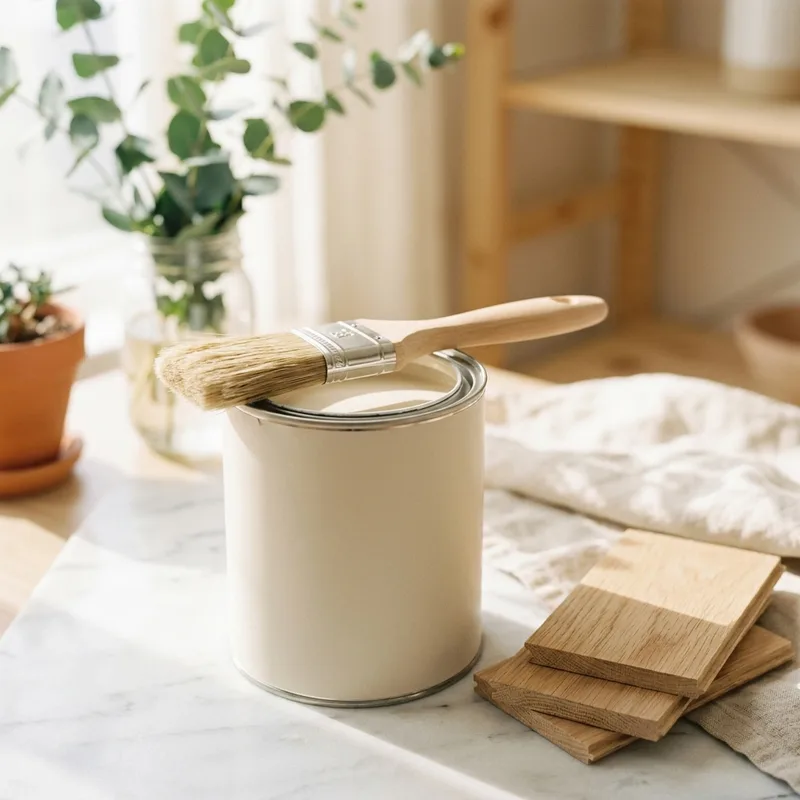
"Non-toxic" on a paint can is a marketing word, not a standard. What actually makes a paint safer comes down to a handful of facts you can check: the VOC (volatile organic compound) number, a third-party emissions certificate such as GREENGUARD Gold, the absence of added heavy metals, and, for anything used in craft or art, an ACMI AP seal or a statement that it conforms to ASTM D-4236. Learn to find those on a label and you can judge any non toxic paint, from a gallon for the bedroom wall to a bottle of acrylic for a kids' project, without trusting the front of the can.
That is the whole job of this guide: give you enough label literacy to read paint yourself. The rules change by use, because a wall, a crib rail, a T-shirt and a child's cheek are four very different exposures. Each of those has its own article in this cluster, and I link to every one of them below. If you already know what you are painting, jump straight there: nursery-safe paint picks for walls and baby furniture, ASTM D-4236 acrylic sets for kids for the craft drawer, and phthalate-free fabric paint for clothes.
Why paint safety is worth a few minutes of your attention
Paint sits on your walls for years and releases vapors while it cures. It gets on little hands during craft time. It coats the crib a teething baby chews. Those are three different exposure routes (breathing, skin, mouth), and that is exactly why one "non-toxic" claim cannot cover all of them.
I will say it upfront: this is not a reason to panic about every can in the garage. Dose and exposure matter. A wall painted five years ago is not your problem. A freshly rolled nursery with the windows shut, or craft paint a toddler is licking off a brush, is where the real difference shows up. The goal is calm literacy, not fear. One swap at a time, starting with the next can you buy.
If you want the bigger picture on why small, repeated exposures add up, we cover it in The Toxic Buildup Effect. Paint is one input among many, and worth getting right when it is easy.
What actually makes paint "non-toxic": five things to check
Forget the front of the can. Turn it around and look for these.
1. VOCs (volatile organic compounds)
VOCs are the solvent chemicals that evaporate as paint dries, the "new paint smell." The US Environmental Protection Agency (EPA) notes that indoor VOC levels can be several times higher than outdoor levels, and that painting is one of the activities that raises them, both during the job and for some time afterward. On a can you will see the figure in grams per liter (g/L). "Zero-VOC" usually means under 5 g/L; "low-VOC" is a looser band that varies by brand and region.
The catch almost nobody mentions: the VOC number on the can usually describes the untinted base. Colorants squirted in at the counter can carry their own VOCs, so a deep navy can end up well above the base figure. The question to ask is always "zero-VOC base and zero-VOC tints?"
2. A third-party emissions certificate
A VOC content number tells you what is in the can. An emissions test tells you what actually comes off the dried wall into the air. That is a different and, for a bedroom, more useful question. GREENGUARD Gold, run by the safety science company UL, tests finished products for chemical emissions against limits set with children and sensitive people in mind. You can look up a specific product in UL's certification directory rather than trusting a logo on a website. A paint can be zero-VOC and still not be GREENGUARD Gold, and vice versa, so the two together are the strongest signal for wall paint.
3. APEs and other additives
Alkylphenol ethoxylates (APEs) are surfactants used in some water-based paints, and better brands have been removing them for years. You will not always see them named, but "APE-free" on a can is a quiet sign the maker pays attention. The same goes for added fragrance (a "fresh scent" paint is masking something, and adding something) and for heavy-duty mildewcides, which belong in a bathroom or on an exterior wall rather than in a nursery.
4. No added heavy metals
Lead, cadmium, chromium and similar metals once appeared in pigments and driers. In the US, the Consumer Product Safety Commission (CPSC) limits lead in paint on toys and children's furniture to 0.009 percent by weight (90 parts per million). Modern wall paint is rarely the issue. Older paint already on your walls, imported art supplies and some vivid artist pigments are where to stay alert. The Centers for Disease Control and Prevention (CDC) states plainly that no safe blood lead level in children has been identified, which is why this one check matters more than any other in an old house.
5. The AP seal and ASTM D-4236 (craft and art paint)
This is the one most people have never heard of, and it matters most for craft, acrylic, fabric and art paints. Under the federal Labeling of Hazardous Art Materials Act (LHAMA), every art material sold in the US must be reviewed by a toxicologist and carry a statement that it conforms to ASTM D-4236, with any chronic health hazard printed on the label, as the CPSC explains in its art materials guidance.
The Art & Creative Materials Institute (ACMI) adds two seals on top. Per ACMI's safety page, the AP (Approved Product) seal means a toxicological evaluation found no materials in amounts harmful to humans, including children. The CL (Cautionary Labeling) seal means the product does carry a hazard and is labeled for safe use, and ACMI says CL products should never be given to children in grade 6 or lower.
So the practical rule for kids' craft paint: an AP seal, or ASTM D-4236 conformance with no hazard warnings on the label. A CL seal means not for kids. A bare "non-toxic" with neither means you do not know.
How to read a paint label in 30 seconds
I keep a mental checklist for every new product, the same habit I use on skincare. Here is the paint version.
| On the label | What it tells you | Good sign |
|---|---|---|
| VOC content (g/L) | Solvent in the base | Zero-VOC (under 5), tints zero-VOC too |
| GREENGUARD Gold | Tested emissions from the dried film | Listed in UL's directory |
| "APE-free," no added fragrance | Careful formulation | Stated explicitly |
| ACMI "AP" seal | Toxicologist found nothing harmful, including for children | Present on craft and art paint |
| "Conforms to ASTM D-4236" | Reviewed and labeled for chronic hazards | Present, with no hazard warning |
| ACMI "CL" seal | Has a hazard, labeled for safe adult use | Not for kids |
| "Non-toxic," "natural," "eco" alone | Marketing claim | Not enough on its own |
My blunt opinion: the word "non-toxic" with nothing behind it is the weakest claim on the shelf. A can that shows a VOC figure and a GREENGUARD Gold listing, or a bottle that shows an AP seal, has told you something you can check. Trust those.
A worked example
Picture two gallons side by side. Can A says "Non-Toxic, Eco Formula" in big green letters and shows a leaf. Turn it around and there is no VOC figure, no certificate, just "low odor." Can B is plainer: "0 g/L VOC, GREENGUARD Gold Certified, APE-free," with a note that the colorant system is zero-VOC. Can A might be perfectly fine, but it has given you nothing to verify. Can B has given you three facts and a directory to look them up in. That is the whole skill.
The same applies to the safety data sheet (SDS). Every paint maker publishes one, usually a quick search away. It is written for workers rather than parents, but the composition section and the hazard statements are a useful cross-check when a can is vague.
Paint categories: which rules apply where
Not all paint is used the same way, so the bar changes by category. Here is the map, with the guide for each.
Wall and ceiling paint
The main exposure is vapor in the air you breathe for days and weeks. Prioritize zero-VOC in base and tint, GREENGUARD Gold where you can get it, and ventilate hard. Water-based (latex or acrylic) paint is far lower in solvents than oil-based (alkyd), which is why I would not use alkyd indoors in a home with kids. For a nursery, our best non-toxic paint for babies and infant spaces walks through three products whose makers publish their ingredients.
Sheen matters more than people think. Flat finishes hide flaws but do not scrub well; eggshell or satin wipes clean, which is useful in kids' rooms and hallways. And do not forget the primer: a zero-VOC topcoat over a solvent-heavy primer only solves half the problem. Ask for a zero- or low-VOC primer too.
Trim, cabinets and furniture
Trim and cabinet paints are often harder enamels, and the conventional ones lean on more solvent. Look for a water-based or waterborne enamel with a published VOC figure. For a dresser, shelf or toy chest, the simplest chemistry is a milk paint (milk protein, lime, clay, earth pigments) or a pure polymerized linseed oil finish with no metallic driers. Both are covered in the nursery picks.
Cribs and anything a baby can mouth
A crib rail is both breathed next to and chewed, so it needs a finish that is fully cured, hard, and free of lead. Wall paint is not automatically crib-safe. The easiest win is a crib with a verified factory finish, so there is nothing to paint at all. If you are finishing raw wood, read non-toxic paint for a baby's crib first. It explains cure time, the tinting gap and the toy-safety standards that apply to chewable surfaces.
Acrylic, finger and craft paint
Water-based acrylic is the broadest entry point: cheap, washable off skin, and everywhere. For kids, the AP seal or ASTM D-4236 with no warnings is the filter. Toddlers who still mouth everything do better with washable finger paint, and the age-by-age rules are in is acrylic paint safe for kids? When you are ready to restock, the best non-toxic acrylic paint for kids' crafts compares sets that state ASTM D-4236 conformance.
Fabric paint
Fabric paint is pigment plus a binder, and sometimes a fixative or plasticizer so the film stays flexible. That is where formaldehyde-releasing agents and phthalates can hide. Look for water-based, ASTM D-4236 or AP, and an explicit phthalate-free claim, then let an adult do the heat-setting with a window open. The criteria are in non-toxic fabric paint that's safe for kids' clothes, and the shopping list is in best non-toxic fabric paint for kids' projects.
Face and body paint
This is where the craft rules stop working. Face paint is a cosmetic, so in the US it falls under the Food and Drug Administration (FDA). The FDA's novelty makeup guidance says the colors must be approved for cosmetic use, some approved colors are still not allowed near the eyes, and a new product should be patch-tested on the arm first. An AP seal is reassuring on a craft bottle, but it does not make a craft paint skin-safe. The full method is in what makes face paint safe.
Hair "paint" and color
"Hair paint" is an informal name for brush-on semi-permanent or temporary color. It is a cosmetic too, with its own ingredients to watch (p-phenylenediamine, or PPD, resorcinol and fragrance) and its own patch-test rule from the FDA. Never use craft paint in hair. See non-toxic hair color: which hair paint products are safe.
Paw-print keepsakes
"Non-toxic" on craft paint is a human rating, and a dog or cat will lick its paw within seconds. A pet-safe ink pad or a clay impression avoids the problem entirely; if you use paint, it should be water-based, fragrance-free and free of xylitol. The step-by-step session is in paw-print keepsakes: which paints are truly safe for pets.
Paint strippers
Removing paint is its own chemistry problem. The EPA has banned consumer sale of methylene chloride paint removers after deaths in poorly ventilated rooms. Soy-based, citrus-based and water-based removers work, just slower. Before you strip anything old, read removing paint safely.
Old paint and lead: the one rule that is not optional
If your home was built before 1978, the most important paint question is not which new can to buy. It is what is already under the top coat. Lead-based paint was banned for residential use in 1978, and the EPA estimates that about three-quarters of homes built before then still contain some.
Intact, undisturbed lead paint is far less of a hazard than lead dust, and dust is exactly what dry sanding, scraping and heat guns create. So before you sand, scrape or demolish anything painted before 1978:
- Test it. The EPA keeps a page on recognized lead test kits, and for a child's room a certified inspection is worth the money.
- If it is lead, do not DIY the removal. Under the EPA's Renovation, Repair and Painting (RRP) program, anyone paid to disturb paint in a pre-1978 home, childcare facility or preschool must be a lead-safe certified firm. You can find one with the EPA's certified firm locator.
- Consider leaving it alone. Sometimes the safest move is sealing a sound old coat under fresh paint (encapsulation), not removing it.
The hub guide to non-toxic building materials covers lead and asbestos in the wider renovation context.
The trade-offs nobody mentions
Being honest about paint means admitting the compromises.
Zero-VOC does not mean zero everything. It caps the regulated volatile solvents. It is a real improvement, not a force field.
Deep colors add VOCs back. If you want a saturated charcoal and truly low VOCs, ask for a zero-VOC colorant system. Not every store has one.
"Natural" and "non-toxic" are not synonyms. Some mineral, clay and milk paints are lovely and genuinely simple. But plant oils and citrus solvents evaporate too, and a natural paint can still smell strong while it cures. Natural is a nice-to-have, not the safety test.
Safer paint asks for more patience. Milk paint has to be mixed, oil finishes cure for days, and zero-VOC flats scrub less well. That is the price of a shorter ingredient list, and for a bedroom I think it is worth paying.
The greenest claim is sometimes the emptiest. A leaf logo tells you about the brand's design team, not its chemistry. Read the back.
How long to air out a freshly painted room
There is no single number, because it depends on the product, the number of coats, humidity and airflow. What the EPA recommends for any VOC source is the same: increase ventilation during the job and afterward. A sensible approach:
- Paint with windows open and a fan pushing air out, not just circulating it.
- Keep ventilating for several days after the room feels dry. Touch-dry and fully cured are not the same.
- For a nursery, finish painting well before the baby moves in, ideally weeks rather than days.
- Use your nose as a backup, not a measuring device. Not every emission smells, but if you can still smell paint, it is still releasing.
If you want to understand the VOC side more broadly, are air fresheners toxic? covers the same chemistry from a different everyday source.
What about the paint that is already there?
A question I get a lot: do you have to strip and repaint everything? No. Use up what you have, then switch, and that applies to walls too. Cured, intact paint is not off-gassing in any meaningful way years later. Repaint when you have a real reason (damage, a new baby's room, a color you cannot live with), and choose better paint then.
If you are refinishing old furniture or an inherited crib, do it safely. Removing paint safely covers the stripper types and when to stop and call a professional.
Paint is one piece of a healthy-home renovation
If you are thinking about paint, you are probably mid-project, which is the best moment to think about floors too, because that is when swaps are cheap rather than disruptive. Flooring is the other big indoor-air decision, and we compare the materials in non-toxic flooring options: what's actually safe.
For how paint, floors, cabinetry and ventilation fit together in a sensible order, the Home & Renovation guide ties the whole area together. If you are setting up a baby's room, the non-toxic nursery checklist puts paint in context with the crib mattress and bedding, and the everyday air-quality basics live in Home & Household.
A simple priority order for a painting project
If you only change a few things, change them in this order:
- Test for lead first in a pre-1978 home. Before any sanding or scraping. This is the step with the biggest downside if skipped.
- Ventilate. Open windows and run fans during and after painting. It is free and does more than any label.
- Match the rule to the job. Zero-VOC base and tint for walls, GREENGUARD Gold where possible; AP or ASTM D-4236 for kids' craft paint; cosmetic-grade for faces.
- Let it cure before heavy use. Give a nursery or a baby's furniture extra time with the windows open.
- Filter the air if you are sensitive. A carbon purifier helps during the cure.
Safer Swaps
Use up what you have, then switch, in this order:
- Switch your next wall paint to a zero-VOC line with zero-VOC tints. When the current can runs out or the next room needs doing, ask the counter about both base and colorant, and check the GREENGUARD directory. Highest impact for the air you breathe daily. For a nursery, start with our infant-safe paint picks.
- Restock the craft drawer with AP-sealed or ASTM D-4236 paint. Next time a bottle runs out, check the label. Easy, cheap and exactly where child exposure is highest. Our acrylic paint picks for kids show what to look for.
- Plan refinishing around a lead test and a safer stripper. Before you strip anything old, read Removing Paint Safely so you do not trade a paint problem for a dust problem.
The Bottom Line
"Non-toxic" is a word. VOC figures, GREENGUARD Gold, the ACMI AP seal and ASTM D-4236 are facts, and in an older home a lead test is the fact that matters most. Turn the can over, match the rule to the job, and give the room time and air.
Your one next step: before your next paint purchase, read the back label for a VOC figure, an emissions certificate or an AP seal. If it shows none of them, put it back and pick the can that tells you something.