Here is the short version: the safest non-toxic fabric paint for kids' clothes and craft projects is water-based, carries the AP seal from the Art & Creative Materials Institute (ACMI) or states that it conforms to ASTM D-4236 with no hazard warning, and is specifically labeled phthalate-free and formaldehyde-free. The phrase "non-toxic" on its own does almost nothing for you, because it is not a regulated claim on art materials. You want the specific certifications and the specific "free of" statements, printed on the tube, not the marketing on the front of the box.
Fabric paint is a quietly tricky category. It is not just pigment: it is pigment plus a binder and often a fixative, and those are where the chemistry you would rather skip tends to hide. In this guide I will walk you through which claims actually mean something, the wash-fastness trade-off you are signing up for with cleaner formulas, how to heat-set safely, and which projects suit which ages. For the actual shopping, our best non-toxic fabric paint for kids' projects compares three water-based sets, so this page can stay focused on the safety criteria. If you are new to paint labels in general, non-toxic paint for every use covers the basics across every kind of paint.
Why "non-toxic" on fabric paint is mostly marketing
"Non-toxic" on its own is not a legal standard for craft paint, and nobody checks that the word on a fabric paint bottle is earned. What does exist is a federal labeling rule: under the Labeling of Hazardous Art Materials Act, every art material sold in the US must be reviewed by a toxicologist, state that it conforms to ASTM D-4236, and print any chronic hazard on the label, as the CPSC explains in its art materials guidance.
On top of that sits the voluntary AP (Approved Product) seal from ACMI. An AP seal means a toxicologist reviewed the formula and found no materials in quantities that would cause acute or chronic harm in normal use, including by children. You can confirm what the seal covers on ACMI's safety page. Its opposite is the CL (Cautionary Labeling) seal, which ACMI says should never be given to children in grade 6 or lower.
So when you are standing in the craft aisle: ignore "non-toxic" as a headline, and hunt for the small AP seal or the ASTM D-4236 line with no warning next to it, plus the specific "free of" statements. If none of that is there, I would put it back.
This is the same problem that runs through most clean-living labels. "Natural," "gentle," "eco" and "non-toxic" are feelings, not facts, until a standard backs them. We go deeper on that in INCI Names Decoded, and the same pattern of unregulated wording shows up on acrylic craft paint, covered in is acrylic paint safe for kids?
What's actually in fabric paint (binders and fixatives)
Pigment is rarely the concern. The binder and fixative are. Many conventional fabric and textile paints rely on formaldehyde-releasing agents to lock color into fibers so it survives the wash, and some flexible formulas have historically used phthalates, the chemicals that keep plastic films soft and stretchy so painted fabric does not crack.
- Formaldehyde-releasing preservatives/fixatives. Formaldehyde is classified as a human carcinogen by the National Toxicology Program, which matters most for inhalation and skin contact over time. In a fabric paint, the real-world exposure is small, but it is an ingredient I would rather not have my kids painting with or wearing against their skin. Context on how small repeated exposures add up is in The Toxic Buildup Effect.
- Phthalates. Used to keep the dried paint film flexible. The CPSC limits eight phthalates to 0.1 percent in children's toys and child care articles, and while craft paint is not one of those categories, that rule tells you how seriously regulators take childhood exposure. A phthalate-free label on a paint aimed at kids is worth looking for specifically.
Water-based acrylic fabric paints can skip both of these and still perform well. That is the category I steer toward.
The claims that actually matter (a label-reading example)
Here is how I read a fabric paint label, in order, the same thirty-second habit I use on every new personal-care product before it comes home:
- AP seal (ACMI) or "conforms to ASTM D-4236" with no warning. One of the two is non-negotiable for anything a child uses. A CL seal or a printed warning means not for kids.
- Water-based. Named on the label or in the cleanup instructions ("cleans up with soap and water"). Solvent-based textile paints are a different, smellier animal.
- Phthalate-free, stated explicitly.
- Formaldehyde-free or "no formaldehyde-releasing agents," stated explicitly.
- Low-VOC / low-odor, helpful for sensitive kids and small rooms.
If a bottle says "non-toxic, washable, for kids" but shows none of the specifics above, that is marketing, not information. I would skip it.
| Label claim | What it actually tells you | Trust level |
|---|---|---|
| "Non-toxic" | Nothing enforceable on its own | Low |
| AP seal (ACMI) | Toxicologist found nothing harmful, including for children | High |
| "Conforms to ASTM D-4236," no warning | Toxicologist-reviewed, no chronic hazard to label | High |
| CL seal or printed warning | Has a hazard; adult use only | Not for kids |
| "Water-based" | No solvents, easy cleanup | High |
| "Phthalate-free" | No plasticizers (if specific) | Medium-High |
| "Formaldehyde-free" | No formaldehyde fixative | Medium-High |
| "Eco / natural / gentle" | Vibe, not a standard | Low |
The wash-fastness trade-off nobody mentions
Here is the honest part. The same formaldehyde and plasticizer chemistry that makes conventional fabric paint survive thirty hot washes is what makes it worth avoiding. Take those out, and cleaner water-based paints usually fade a little faster and crack a little sooner, especially on high-wear items washed often.
I am not going to pretend that trade-off does not exist. It does. For a tote bag, a pillow, a one-season craft shirt or a school project, it does not matter at all. For a garment you want to look crisp two years from now, a cleaner paint will soften and lighten sooner, and that is the price of the cleaner formula.
My rule: match the paint to the project's lifespan. A craft that lives on the fridge or gets worn for a summer owes you nothing in durability. Do not buy harsher chemistry to win a wash-fastness contest a kids' tote bag was never entered in.
Heat-setting safely
Most water-based fabric paints need heat-setting to become washable: you set the color with an iron (usually a few minutes of medium-dry heat through a cloth) or a hot dryer cycle, per the bottle. This step is normal and fine. Two safety notes worth stating plainly:
- The adult does the ironing, always. Heat-setting is not a kid step. Children paint; grown-ups set.
- Ventilate while you set. Even a clean water-based paint can give off a faint odor when heated. Open a window or run a fan. Let the piece cure fully (often 24 to 72 hours) before the first wash so the color actually locks.
Follow the specific bottle instructions over any general rule, because set temperatures and times vary by brand.
When you are ready to pick actual bottles rather than parse labels, this is the moment to hand off:
Which projects suit which ages
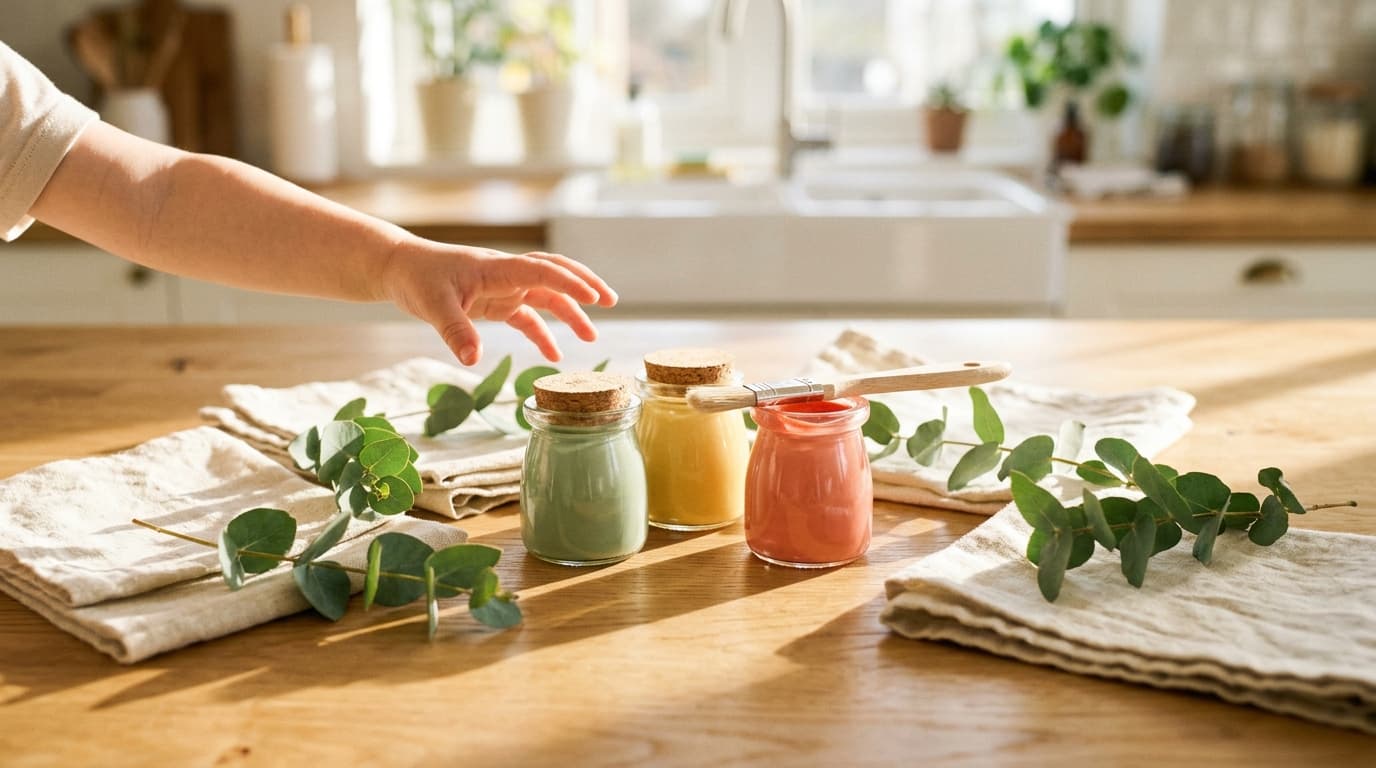
Fabric paint is a craft, and craft safety is mostly about keeping paint out of mouths and off faces. A rough guide:
- Toddlers (under 3): paint goes everywhere, including in the mouth. Even an AP-sealed paint is for making art, not snacking. Keep it to supervised, washable-smock sessions on paper or scrap fabric, and honestly, this age is better served by chunky washable markers than fabric paint. (Looking for safe art supplies generally? See our notes on acrylic paint for kids.)
- Ages 3 to 6: stamping, finger-dabbing and simple tote-bag projects work well with close supervision. Water-based, with an AP seal or an ASTM D-4236 statement, only. Squeeze-bottle puff paint is easier for this age than brushwork.
- Ages 7 and up: brushwork, T-shirt designs, fabric markers. This is the sweet spot for fabric paint.
Face and skin are a separate category entirely. Fabric paint is not skin paint, no matter how "non-toxic" the label. If the project is a costume or a party, use a product made for skin: see what makes face paint safe. The same goes for pets: craft paint is not paw paint either, and our guide to pet-safe paw-print keepsakes covers what to use instead.
A note on the blank fabric itself
One thing the paint guides tend to miss: what you paint matters too. A plain 100% cotton tote or tee takes water-based paint beautifully and is a cleaner starting canvas than a synthetic blend treated with wrinkle-resist finishes (often formaldehyde-based). If you can, start with undyed or lightly dyed natural-fiber blanks. Clothing is, honestly, the area with the most room for improvement in my own home, so I will not pretend I have this perfectly sorted, but the fiber under the paint is worth a thought. If you are choosing fabrics for a child's room too, best organic kids bedding explains what the GOTS and OEKO-TEX labels cover.
How to paint a kids' T-shirt, step by step
The method matters as much as the paint for how long a design lasts.
- Prewash the blank without fabric softener. New fabric often has a finish (sizing) on it that stops paint from soaking in.
- Slide cardboard inside the shirt so paint does not bleed through to the back.
- Paint thin. Thick blobs crack when the fabric flexes; two thin layers last longer than one thick one.
- Let it dry fully, usually overnight, then an adult heat-sets it per the bottle.
- Wait before the first wash. Many brands ask for a few days. Then wash inside out, cold, and skip the softener.
- Wash before the first wear if your child has sensitive skin, to remove any loose residue.
Fabric markers are a good alternative for kids who want detail without the mess. The same label rules apply: water-based, and an AP seal or ASTM D-4236 statement with no warning.
Where I'd actually spend my energy
If you are new to all this, do not let fabric paint become a whole research project. It is a craft supply, not a crib mattress. The highest-value move is simply buying one water-based, phthalate-free paint set with an AP seal or ASTM D-4236 statement and using it well, rather than owning twelve bottles of mystery chemistry. The early mistake I made across our whole house was trying to replace everything at once; it got expensive fast and it was not necessary. One good swap beats a panicked overhaul every time. If you want the gentle starting order for the rest of the house, where to start on a budget lays it out.
For the wider picture of safer choices from nursery to playroom, non-toxic living for kids and family is the hub.
Safer Swaps
Use up what you already have first; a half-finished bottle that works is not a crisis. When you restock, switch in this order:
- Swap unlabeled "non-toxic" fabric paint for a water-based set with an AP seal or ASTM D-4236 statement. Highest impact, easiest to do: this one change covers the binder-and-fixative worry for almost every kids' project. See our phthalate-free fabric paint picks.
- Swap synthetic, wrinkle-resist blanks for plain cotton totes and tees. A cleaner canvas and it takes paint better anyway.
- Swap fabric paint out entirely for face or skin projects. Use a product actually made for skin instead: non-toxic face paint.
The Bottom Line
"Non-toxic" on a fabric paint bottle is a feeling. The AP seal or an ASTM D-4236 statement with no warning, "water-based," "phthalate-free" and "formaldehyde-free" are the facts. Your next step is small: next time you buy fabric paint for a kids' project, flip the bottle over and check for those four things before it goes in the cart. If they are there, paint away, set it with a window open, and enjoy the slightly-less-permanent, much-cleaner result.
Sources: the Art & Creative Materials Institute on the AP seal, the NIEHS overview of formaldehyde, and the CPSC on phthalates in children's products.