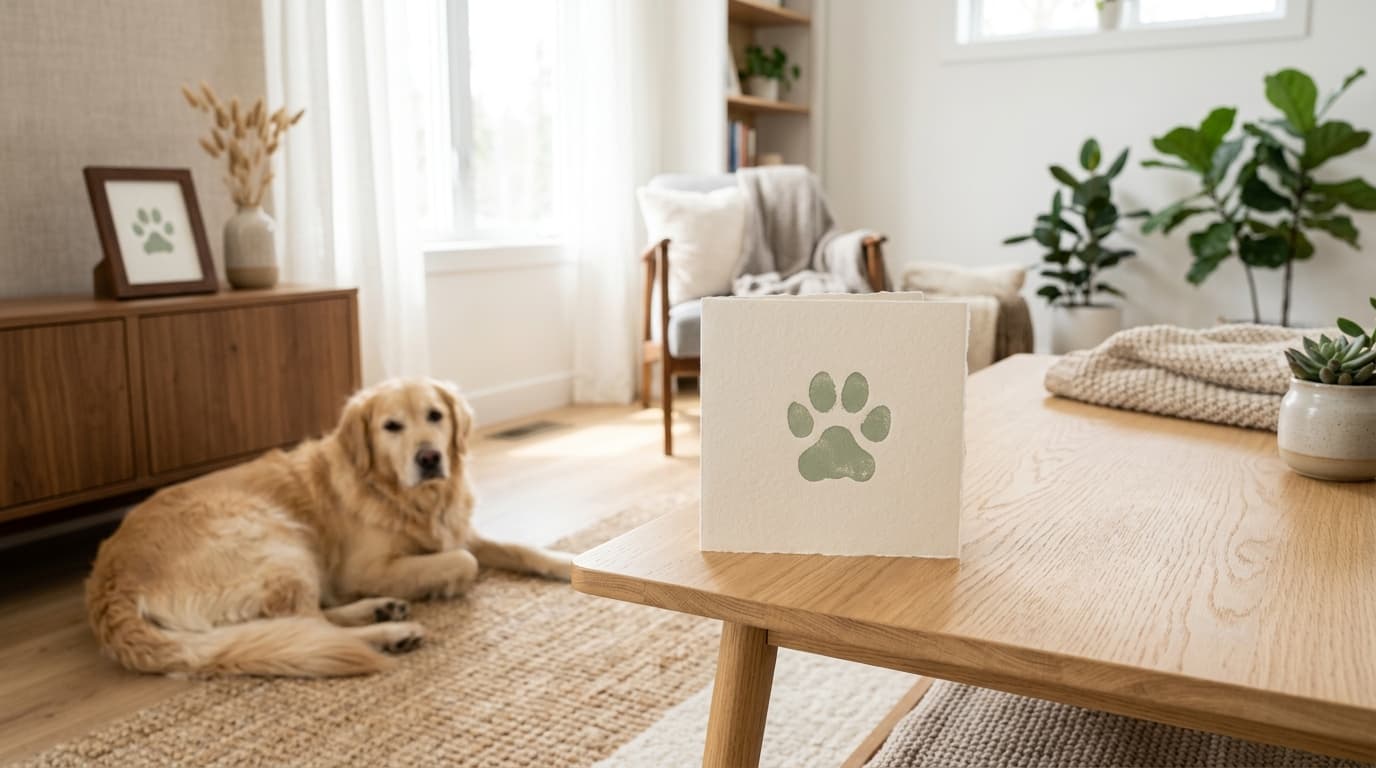
Here is the thing nobody tells you when you reach for the craft paint to capture your dog's little toe beans: a paint labeled "non-toxic" is almost always rated for humans, not animals. The two are not the same. A pet licks the paint straight off its paw within seconds, so the real question is not "is this safe on skin?" but "is this safe to swallow?" The safest choice is a water-based, pigment-only paint with no added fragrance, minimal preservatives, and absolutely no xylitol or heavy-metal pigments. Better still for a nervous first-timer: a pet-safe ink pad that uses no liquid paint at all.
I am not a vet, and I want to be calm about this rather than scary. Most paw print sessions end with nothing worse than a confused dog and a slightly smudged keepsake. But because the whole point of this project is love, it is worth spending five minutes getting the paint right. Let's walk through what "pet-safe" actually means, how to run a clean session, and what to do if your pet gets a mouthful.
Why "Non-Toxic" on the Label Does Not Mean "Pet-Safe"
The "non-toxic" seal you see on craft paint usually refers to the ASTM D-4236 standard, which evaluates whether a product is hazardous to humans under normal art use. It says nothing about a Labrador licking a palm-sized blob off its pad.
Humans do not eat their paint. Pets do, immediately and enthusiastically. That single behavioral difference changes everything. An ingredient that is harmless on your fingertip can become a problem once it is swallowed in a concentrated dose by a 12-pound animal. So when you read "non-toxic," translate it in your head to "non-toxic to a person who is not eating it." For a paw print, you need the next level up.
This is the same trap we fall into all over the home: a label that is technically true but answers a different question than the one you are asking. Our guide to non-toxic paint for every use explains what the AP seal and ASTM D-4236 actually certify, for people. If you want the broader picture of how marketing language and real safety diverge, our guide on understanding ingredient names and labels is a good companion read.
What Actually Makes a Paw Print Paint Pet-Safe
A genuinely pet-safe paint is defined more by what it leaves out than what it adds. Here is what I look for.
Water-based, not solvent-based. Skip anything oil-based or anything that needs mineral spirits to clean up. Water-based acrylics and tempera rinse off with plain water, which matters when the clock is ticking.
Pigment-only, simple color. The fewer the ingredients, the fewer the surprises. Watch out for certain pigments: traditional cadmium (reds, yellows, oranges), cobalt (blues), and chromium-based colors have been associated with heavy-metal toxicity. Reputable brands now use safer synthetic alternatives, but cheap craft paint is a question mark. When in doubt, choose a brand that discloses its pigments.
No xylitol. This is the big one. Xylitol, the sugar substitute, is highly toxic to dogs even in small amounts and can cause a dangerous drop in blood sugar. It turns up in some scented or "sweet-smelling" craft products and children's items. It has no business near a paw print. The FDA has a clear warning on xylitol and dogs worth reading once.
No added fragrance. Fragrance is a catch-all term that can hide dozens of undisclosed compounds (we unpack it in is fragrance in products safe?), and it adds nothing but risk to a product your pet will taste. Fragrance-free is the only sensible choice here.
Low or no harsh preservatives. Some preservatives (certain isothiazolinones) are common skin irritants. A small, simple ingredient list usually means fewer of them.
The thirty-second habit that saves you
Before I buy any new product that touches skin in our house, I look it up on INCIdecoder, an ingredient database, or paste the list into our ingredient label checker. It takes about half a minute and has become a reflex. For paw print paint, do the same: read the full ingredient list, not the front of the bottle, and if you cannot find one, treat that as your answer.
The Safest Options, Ranked
Not every pet needs the same approach. A patient senior dog is different from a wriggling kitten who treats everything as prey. Here is how I would rank the options from safest and easiest to most hands-on.
| Option | Pet-safety level | Best for | Trade-off |
|---|---|---|---|
| Pet-safe ink pad (no liquid paint) | Highest | Cats, squirmy dogs, first-timers | Limited colors, one print per session |
| Clay or dough impression kit | Highest | Owners who want a 3D keepsake | No color, needs drying time |
| Pet-formulated water-based paint | High | Calm dogs, color lovers | Costs more than craft paint |
| Children's washable tempera or finger paint | Moderate | Budget sessions, supervised | Must wipe fast, read ingredients |
| Watercolor | Moderate | Light, soft prints on paper | Faint color; wipe fast |
| Standard craft acrylic | Low | Not recommended | Pigment and additive uncertainty |
If you go the children's-paint route, the same label rule as for kids applies as a minimum: water-based, with an ACMI AP seal or an ASTM D-4236 statement and no warning (our guide to whether acrylic and finger paint are safe for kids explains both). Then add the pet-specific checks above, because those labels were written for children, not dogs.
My honest opinion: for a cat or a nervous dog, skip liquid paint entirely and use a clean-touch ink pad. You avoid the wet-paw panic, the smearing, and the licking window almost completely. For a mellow dog who will sit still, a paint made specifically for pet prints is worth the few extra dollars over bargain craft paint.
How to Do a Safe Paw Print Session, Step by Step
Preparation is everything. A rushed session is where paint ends up licked and tempers get frayed. Set up before your pet is in the room.
- Gather everything first: paint or ink pad, paper or canvas, a damp cloth, a dry towel, and a treat. You want zero scrambling once paws are involved.
- Pick your moment. Right after a walk or a meal, when your pet is sleepy and relaxed, not mid-zoomies.
- Apply a thin layer. A light coat on the pad gives a cleaner print and leaves far less to lick off. Globs are the enemy.
- Press, lift, and immediately distract. Have a helper offer the treat the second the print is made, so your pet's attention goes to the snack, not the paw.
- Wipe the paw right away with the damp cloth, then dry it. Do not let the paint sit or dry on the pad.
- Keep the session under a minute. Speed is your best safety tool.
If your pet hates having its paws touched, do not force it. A stressed animal is not going to give you a keepsake you enjoy looking at anyway. The ink pad or a clay impression is kinder in that case.
Drying and preserving the keepsake
The print is only half the job. A few things keep it safe and lasting:
- Let it dry out of reach. A drying canvas on the coffee table is an invitation to sniff and lick. Put it up high or in a closed room.
- Frame it rather than spray it. Spray varnish and fixatives are solvent-based, the kind of product I would not use with a pet in the room. A frame with glass protects the print with no chemistry at all. If you do want a sealer, apply it outdoors and let it cure fully before the print comes back inside.
- For clay prints, follow the kit's drying time and keep the impression away from pets until it is fully hard, because damp air-dry clay is tempting to chew.
What To Do If Your Pet Licks or Swallows Paint
First, do not panic. A small lick of a water-based, pet-appropriate paint is very unlikely to cause real harm. The goal here is sensible, not scary.
If your pet licks a little: wipe the paw, offer fresh water, and watch for any mild stomach upset over the next few hours. Most pets are completely fine.
Call your vet or a poison line if you see vomiting, drooling, lethargy, loss of coordination, or if you know the product contained xylitol, solvents, or questionable pigments. With xylitol especially, do not wait for symptoms: contact help immediately. Keep the product label handy so you can read the ingredients to whoever answers.
Useful numbers to save now: the ASPCA Animal Poison Control Center and the Pet Poison Helpline both operate around the clock. A consultation fee may apply, but it is money well spent for peace of mind.
The simplest insurance is prevention: a thin coat, a quick wipe, and a treat-based distraction mean most pets never get a proper taste in the first place.
A Note on the "Natural" Trap
I love a natural product. But "natural" on a paint bottle is not a safety guarantee for pets, and I would not let the word do the thinking for me. Essential oils are natural and several of them (tea tree, citrus, and others) are toxic to cats and dogs. "Plant-based" fragrance is still fragrance. Natural does not automatically mean lickable.
This is the same healthy skepticism we bring to the rest of the home. A product earns trust through a clear, short ingredient list and honest labeling, not through a reassuring adjective. If you want to understand which ingredients genuinely deserve caution versus which are marketing noise, our overview of chemicals worth eliminating sorts the real concerns from the hype.
Safer Swaps
Nothing here needs using up; just make the next keepsake a smarter one. In priority order:
- Swap liquid paint for a pet-safe ink pad. Easiest, highest impact. No wet paw, almost no licking window, and clean-touch versions keep color off the fur entirely. This is my first recommendation for cats and wriggly dogs.
- Swap bargain craft acrylic for a paint formulated for pet prints. If you want color and your dog is calm, choose a water-based, fragrance-free, xylitol-free product that discloses its pigments, and read the full ingredient list before you buy.
- Swap paint for a clay impression kit if you want a keepsake with zero ingestion risk at all. A pressed 3D print in air-dry clay is beautiful, permanent, and nothing goes on the paw that cannot be rinsed.
If the kids want to make their own handprint next to the paw print, the same session works with a washable children's paint, and our children and family hub covers the rest of the craft drawer. For the air side of a pet-friendly home (candles, sprays, cleaning products), are air fresheners toxic? is a good next read.
The Bottom Line
The one thing to remember: "non-toxic" on craft paint is a human rating, and your pet is going to lick the paint. So choose a water-based, fragrance-free, xylitol-free, pigment-disclosed product, or sidestep liquid paint entirely with a clean-touch ink pad.
Your next step is simple. Before you make a single print, read the full ingredient list on whatever you plan to use, and if you cannot find it or spot xylitol, fragrance, or mystery pigments, pick a product that is actually made for pets. Then set up your supplies, keep the session under a minute, and have the treat ready. A thin coat and a quick wipe turn a loving little project into exactly what it should be: a keepsake, not a worry.