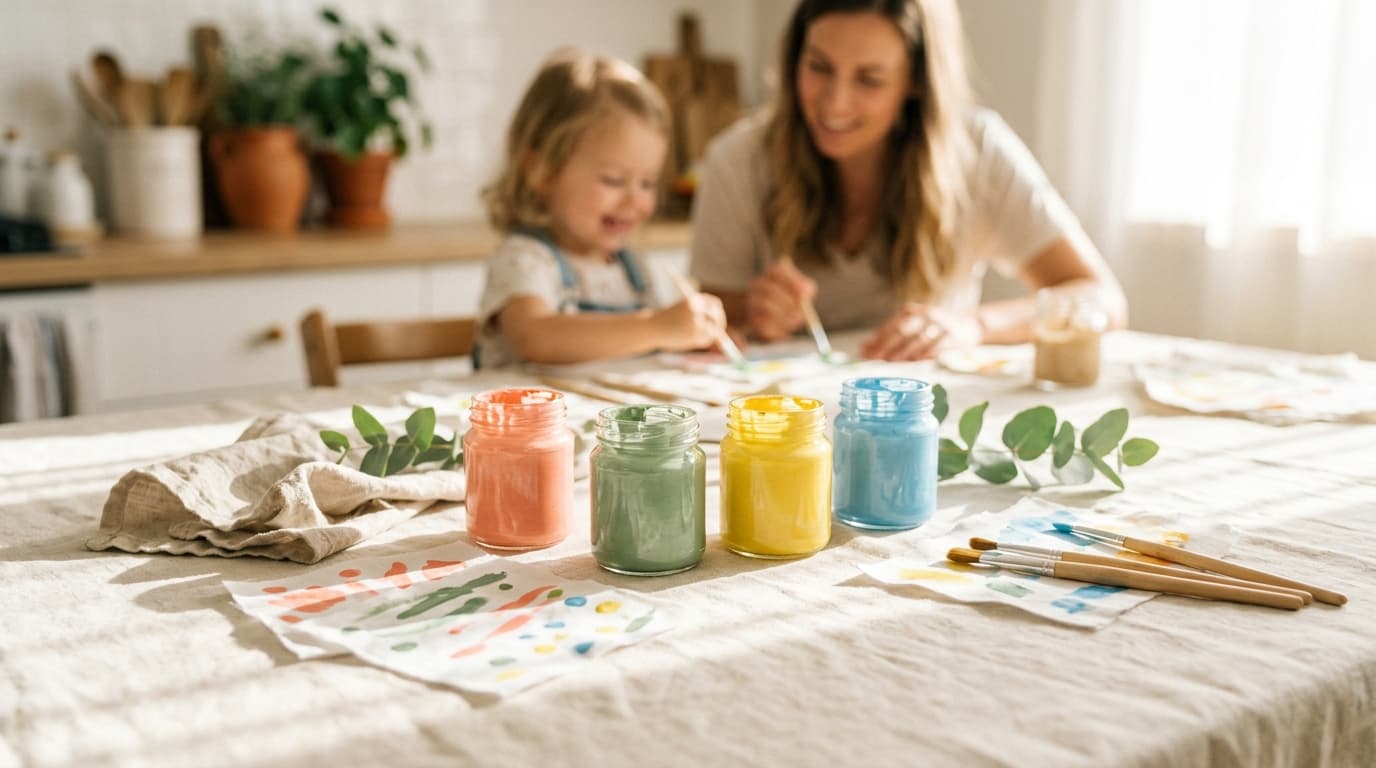
The best non-toxic fabric paint for kids is water-based, carries an AP (Approved Product) seal or states that it conforms to ASTM D-4236 with no hazard warning, is phthalate-free where the maker says so, and holds up in the wash so the design does not crack off after one cycle. For most families, a water-based set from Tulip or Shuttle Art checks those boxes and heat-sets well; if your child has sensitive skin, lean toward fragrance-free paint and wash the painted item before it touches skin. A note up front: none of the three picks below displays an ACMI AP seal on its listing. All three makers state ASTM D-4236 conformance (for Tulip, stated for the product line), which is the bar this guide uses, and I say on each pick what is and is not verified.
Fabric paint is one of those products parents rarely think about until a craft kit lands on the kitchen table. The good news: this is an easy category to shop safely, because the better options are already water-based and certified. The trick is reading past the word "non-toxic" on the front of the bottle (which means almost nothing on its own) and checking what actually backs it up. Below is how I would vet any fabric paint, then three picks worth your money. For the ingredient side (binders, fixatives, heat-setting), our non-toxic fabric paint safety guide goes deeper.
This page contains affiliate links. If you buy through them we may earn a small commission at no extra cost to you. We only recommend products that meet the criteria below.
What Makes Fabric Paint Genuinely Low-Tox
"Non-toxic" on a label is a marketing word, not a standard. What you actually want to see is a certification and a formula you can read. Four things matter:
Water-based, not solvent-based. Water-based fabric paints skip the harsh solvents that off-gas strong fumes. For kids painting at a table, this is non-negotiable. If the cleanup instructions say "use mineral spirits," put it back.
AP seal or ASTM D-4236. The AP (Approved Product) seal from the Art & Creative Materials Institute means the product was reviewed by a toxicologist and contains no materials in quantities harmful to humans, including children; ACMI's safety page explains what it covers. The seal is voluntary. What every US art material must carry is a statement that it conforms to ASTM D-4236, the labeling standard under which a toxicologist reviews the formula and any chronic hazard is printed on the label, per the CPSC's art materials guidance. ASTM D-4236 with no warning is the minimum; a CL (Cautionary Labeling) seal or a printed warning means not for kids.
Phthalate-free. Phthalates are the chemicals that make plastics soft and help some coatings stay flexible. The CPSC permanently banned several phthalates above 0.1% in children's toys and childcare articles, and while craft paint sits in a gray zone, it is worth choosing a formula that states phthalate-free outright.
Wash-fastness. This is the practical one. A paint can be perfectly safe and still flake off a T-shirt in the first wash. Look for "permanent," "washable once heat-set," or a stated wash rating. Heat-setting (a quick press with an iron through a cloth) locks most water-based fabric paints in.
A quick word on "non-toxic" labels
Here is my blunt take: ignore the big "NON-TOXIC" banner on the front and flip to the certification line. A paint with an AP seal, or an ASTM D-4236 statement and no warning, has been reviewed by someone qualified. A paint that just says non-toxic in a friendly font has told you nothing. In full honesty, none of the specific picks below carries a visible AP seal; I recommend them because their makers state ASTM D-4236 conformance and water-based formulas with a permanent-once-heat-set finish, and because wash-before-wearing (covered below) removes the main residual-exposure concern. None of the three publishes a full ingredient list, so a phthalate-free claim cannot be verified beyond the label. That is the real trade-off, stated plainly. If you want to go deeper on how this plays out across craft supplies, our guide to non-toxic fabric paint that's safe for kids' clothes and crafts covers the ingredient side, and the broader acrylic paint safety guide is worth a read if your kids craft a lot.
Our Top Picks at a Glance
One rule to shop by: match format to age and project, then compare by volume. For kids under 6, pick squeeze or puff formats that don't need brush control; for ages 6+, flat brush-on sets give finer detail. Then compare value by total millilitres, not by bottle count: the Shuttle Art kit (18 x 60ml = 1,080ml) and the 14-color 2oz set (14 x 59ml ≈ 826ml) give you the most paint to work with.
| Product | Best For | Key Material or Certification | Why It Wins |
|---|---|---|---|
| Tulip Puff Paint 20-Color Party Pack | Best Overall | Water-based, ASTM D-4236 for the line per the maker | Trusted brand, huge color range, dimensional effect kids love |
| Shuttle Art Fabric Paint 18-Color Kit | Best All-in-One Kit | Water-based, ASTM D-4236 per the maker | Brushes, palette and stencils included for a full craft setup |
| Colorful Fabric Paint 14-Color 2oz Set | Best for Generous Coverage | Water-based, ASTM D-4236 per the maker | Larger 2oz bottles mean fewer refills on bigger projects |
Best Overall: Tulip Puff Paint 20-Color Party Pack
Tulip is the name most craft-store parents already recognize, and this 20-color dimensional set is the one I would hand to a mixed-age group of kids. It is water-based, nontoxic, and permanent on fabric once dry, and the puff effect gives beginners instant, satisfying results without needing brush skill. Why this over the others: it's the only pick whose dimensional, raised finish works without any brush technique, so a 4-year-old gets a clean result the brush-on kits can't match. No AP seal is listed; the maker states the Tulip fabric paint line conforms to ASTM D-4236, and the formula is water-based and permanent once dry.
Pros:
- Twenty colors from a well-established, trusted brand
- Water-based and permanent on fabric once set
- Dimensional "puff" style is forgiving for young kids and non-artists
- Multi-surface, so it stretches beyond fabric
Cons: The raised, puffy finish is a specific look. If you want flat, paint-on-canvas style coverage, this is not the right pick.

Best All-in-One Kit: Shuttle Art 18-Color Fabric Paint
If you are starting from zero, this is the box I would buy. Shuttle Art's 18-color set is water-based and nontoxic, and it arrives with brushes, a palette and stencils, so there is no separate shopping trip before the kids can start. Why this over the others: it's the only pick that includes the tools (brushes, palette, stencils) in the box, and at 1,080ml total it also lands among the best on ml-per-dollar. No AP seal is listed; the maker states ASTM D-4236 conformance and a water-based formula.
Pros:
- Eighteen colors plus brushes, palette and stencils included
- Genuine all-in-one value, nothing extra to buy
- Water-based, nontoxic textile formula
- Works across T-shirts, shoes, canvas bags and jeans
Cons: For a single small project, 18 bottles at 60ml each is more paint than you will realistically use. You will have leftovers.

Best for Generous Coverage: Colorful Fabric Paint 14-Color 2oz Set
When the project is bigger (a tote bag, a pillowcase, a full T-shirt design), you do not want to run dry halfway through. This kid-focused 14-color set uses 2oz bottles, which is a comfortable amount for larger surfaces. Why this over the others: with roughly 826ml of brush-on paint across larger single bottles, it covers a full tote or pillowcase in one sitting without the puff texture or the need to refill. No AP seal is listed; the maker states ASTM D-4236 conformance and a water-based formula.
Pros:
- Fourteen colors at 2oz each for real coverage
- Water-based and nontoxic, designed with kids in mind
- Flat brush-on finish for canvas-style coverage
- Good fit for larger or multi-garment projects
Cons: As a newer listing, it has a shorter track record than the established brands above.

How We Chose
We prioritized water-based formulas, an AP seal or a stated ASTM D-4236 conformance, phthalate-free claims where makers make them, and a usable wash-fastness story (permanent once heat-set). We also weighed real-world reliability through long review histories where available, and favored kid-focused products that are easy to use at a family craft table. We have not personally lab-tested these paints; our picks reflect published formula information, certifications and the track record each product carries.
The Sensitive-Skin Pick (And Why Washing Matters)
If your child has eczema or reactive skin, here is my honest position: any of the water-based picks above is a reasonable starting point, but the step that matters most is not the brand, it is washing the finished garment before it is worn. Dried, heat-set, water-based fabric paint sits on the fabric surface, and a wash removes any loose residue. Choose a fragrance-free formula where you can, keep paint off bare skin during the project (fabric paint is not made for skin; for that, see what makes face paint safe), and do a tiny patch test on the inside of the garment if your child is highly reactive.
This mirrors something I have learned living low-tox with kids: I change what is clearly mine to change, and I make the sensible adjustments (wash before wearing, patch test) rather than chasing a "perfect" product that does not exist. For the wider picture on skin-contact products for children, our non-toxic living for kids and family guide pulls the pieces together, and for brush-and-canvas projects rather than clothing, see the best non-toxic acrylic paint for kids.
Care, Wash-Fastness and Making the Design Last
Water-based fabric paint is only as permanent as your heat-setting. After the paint dries fully (give it the full time on the label, not a rushed hour), place a thin cloth over the design and press with a warm iron for the stated time, or follow the brand's heat-set instructions. This locks the pigment into the fibers.
A few practical notes from a low-tox household:
- Wait the full cure time before the first wash. Rushing it is the most common reason designs crack.
- Wash painted items inside out, cold, on a gentle cycle, with a fragrance-free laundry detergent if skin is sensitive.
- Skip fabric softener on freshly painted pieces; it can interfere with adhesion.
- Air dry when you can; high heat in the dryer is hard on any painted fabric.
What to Avoid
Skip anything solvent-based, anything that lists no certification and no ingredients, and any craft paint marketed for general use that does not say it is permanent on fabric (it will wash straight out). Be wary of strongly scented fabric paints if skin sensitivity is a concern, since fragrance is a common irritant. And if a product makes big "non-toxic" claims but gives you nothing to verify them, treat the claim as marketing. For the chemicals worth knowing about across your whole home, our top chemicals to eliminate guide is a useful companion, and non-toxic paint for every use covers labels on every other kind of paint.
When to Replace
Fabric paint does not last forever. Toss bottles that have dried out, separated permanently, or developed an off smell, and replace anything that has frozen (water-based paint can split after a hard freeze). If you only craft occasionally, the smaller sets above are the smarter buy precisely because you will not be stuck with half-used bottles going bad in a drawer.
Safer Swaps
In priority order, easiest and highest impact first. Use up what you already have, then switch.
- Swap solvent-based or unlabeled craft paint for a water-based fabric paint with an AP seal or ASTM D-4236 statement. This is the single biggest improvement and costs no more than a conventional set. The Tulip or Shuttle Art kits above are easy starting points.
- Add the wash-before-wearing habit. Free, and it does more for sensitive skin than any brand switch. See our kids and family hub for more small, repeatable wins.
- Match bottle size to the project. Big bottles for big projects, tiny sets for classrooms, so paint does not sit and spoil. Pair this with the ingredient deep dive in our fabric paint safety guide.
The Bottom Line
Non-toxic fabric paint is one of the easier low-tox swaps you will make: pick a water-based formula with an AP seal or an ASTM D-4236 statement and no warning, phthalate-free where stated, with a permanent-once-set finish, and you are most of the way there. If you want one box to start with today, the Shuttle Art 18-color kit gives you paint plus the brushes and stencils to actually use it, and the Tulip puff paint set is the crowd-pleaser for mixed-age kids. Whichever you choose, wash the finished piece before it is worn, and you are done.