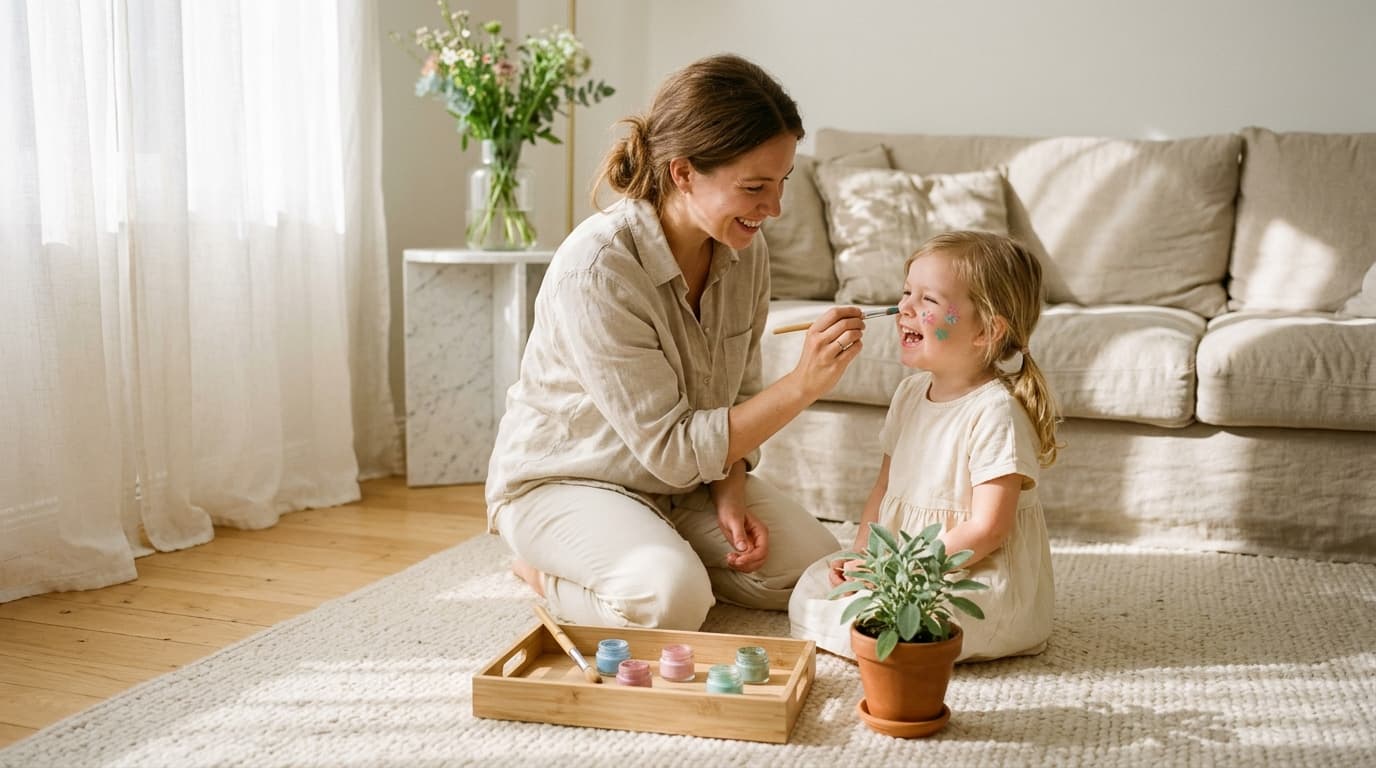
The word "non-toxic" on a tube of face paint tells you less than you think. For face paint to be genuinely safe, it needs to be a cosmetic-grade product made for skin: one that uses FDA-approved color additives, skips heavy metals, parabens and synthetic fragrance, and is actually labeled as face or body paint, not craft paint. The "non-toxic" seal you see on craft products means a toxicologist found nothing harmful in normal craft use. That is not the same as safe to leave on a child's cheek for six hours.
Here is the good news before we go any further: face paint is a joy, and I am not here to ruin Halloween. A butterfly on your kid's face at a birthday party is a lovely thing. The risks are real but modest and very avoidable once you know which two or three things to check. This guide gives you a label-reading method so you can pick a product in the store aisle in under a minute, plus the honest line on DIY, which is more complicated than Pinterest suggests.
What "non-toxic" actually means on a face paint label
This is the single biggest source of confusion, so let's clear it up first.
In the US, face paint sold as a cosmetic is regulated by the Food and Drug Administration (FDA), which restricts which color additives can be used on skin and, specifically, which can go near the eyes. A proper cosmetic face paint has to work within that list. The FDA's own novelty makeup guidance puts it simply: if a color on the ingredient list is not on the agency's summary of approved color additives, do not use the product.
Craft paint is a different animal. When you see the "AP Non-Toxic" seal on craft acrylics or tempera, that certification comes from the Art & Creative Materials Institute (ACMI) and means a toxicologist found no materials in harmful amounts in normal art use, including by children. That is the right bar for a craft paint, and if a children's face paint kit also carries an AP seal or an ASTM D-4236 statement, that is a reassuring extra. But on its own it says nothing about whether a paint is made to be worn on skin for hours. Craft acrylic is designed to bond to canvas and dry hard; on your pores it can irritate, trap bacteria and be miserable to remove. We go deeper on this in Is Acrylic Paint Safe for Kids?, but the short version: never use craft paint on faces.
So the rule is simple. "Non-toxic" on craft paint means safe for crafts. You want skin-safe, which is a different claim. Look for the words "face paint," "body paint" or "cosmetic grade," not "craft." If you want the label basics for every other kind of paint, non-toxic paint for every use lays them out side by side.
The ingredients worth avoiding on skin
Face is delicate skin, often near eyes and mouth, and sometimes broken (that little scratch under the chin). That is where exposure matters most. Here is what I check for.
Heavy metals
Independent testing over the years has turned up lead, nickel, chromium and cobalt in some novelty and imported face paints, usually as contaminants in the pigments rather than added on purpose. Lead has no safe level of exposure, especially for children, per the CDC. You cannot see metals on a label, which is exactly why buying from a reputable cosmetic brand that tests its batches beats grabbing the cheapest Halloween-aisle kit.
Parabens and synthetic fragrance
Parabens are preservatives (the evidence is more nuanced than the headlines; see are parabens bad for you?); synthetic fragrance is a catch-all "parfum" that can hide dozens of undisclosed ingredients, some of them common skin sensitizers, as we explain in is fragrance in products safe? Neither is an emergency, but on a face, near eyes, on skin that may be scratched, I would rather skip both. Fragrance in particular is a leading cause of contact allergy. If you want the full ingredient-decoding method, INCI Names Decoded walks through reading a cosmetic label line by line.
Harsh color additives near the eyes
The FDA is strict about which colors can be used in the eye area, and for good reason. Some colorants approved for lips or general use are not approved near eyes. A trustworthy brand will tell you if a shade is not for eye-area use, and the FDA says to heed that warning even if the packaging photo shows paint around the eyes. Cheap kits often do not.
Neon and glow-in-the-dark colors
These are the Halloween favorites, and they come with the tightest rules. Per the FDA, eight fluorescent ("neon") colors are approved for cosmetics with usage limits, and none of them is allowed near the eyes. For glow-in-the-dark, only one color, luminescent zinc sulfide, is approved, for limited use and not near the eyes. So keep neon and glow shades to cheeks, arms and hands, and save the area around the eyes for standard colors labeled as eye-safe.
What certifications and labels to actually look for
You do not need a chemistry degree. You'll want to recognize a few signals.
| Label or claim | What it really tells you | Trust level |
|---|---|---|
| "AP Non-Toxic" or ASTM D-4236 (craft labels) | Safe for normal craft use; on its own NOT a skin-wear claim | A plus on a kids' kit, never enough alone |
| "FDA-compliant cosmetic" / lists FD&C or D&C colors | Uses skin-legal color additives | Good |
| "Face and body paint" | Formulated for skin wear | Good |
| "Paraben-free, fragrance-free" | Fewer common irritants | Good bonus |
| "Natural" / "non-toxic" alone | Marketing, no fixed standard | Weak |
| Full INCI ingredient list printed | You can actually check it | Best |
My honest opinion: the single most reassuring thing on a face paint package is a full ingredient list written in INCI names. A brand that hides its ingredients behind "natural mineral formula" and a cute font is making a marketing choice, not a transparency one. Skip it. A brand that prints every colorant and preservative is one you can verify.
This is where a 30-second habit pays off. Before I buy any new personal-care product, I look it up on INCIdecoder, an ingredient database that explains what each line does, or run it through our ingredient label checker. It takes half a minute and has saved me from more than a few "clean"-looking products that were not. The same trick works for face paint with a printed ingredient list.
Water-based vs oil-based vs "non-toxic" kits
Three formats, and they are not equal.
Water-activated cake paints (the kind professional face painters use, applied with a wet brush or sponge) tend to be the cleanest, most pigmented and easiest to remove with soap and water. They are my preference for kids.
Oil or grease-based paints give the heavy, opaque look for special-effects makeup and Halloween characters. They last and resist smudging but are harder to remove and more likely to clog pores on an all-day wear. Fine occasionally; not for a toddler's weekly dress-up.
Cheap mystery kits from the seasonal aisle are the ones I would skip. No ingredient list, unknown pigment sourcing, and the dreaded "non-toxic" stamp doing a lot of heavy lifting. If the brand will not tell you what is in it, that is your answer.
Natural mineral and clay kits sit somewhere in between. Several small brands sell face paint made from clays, mineral pigments and plant oils, and state that they are free of heavy metals, parabens and synthetic fragrance. Those are the maker's claims rather than independent test results, so the same rule applies: a full ingredient list you can read, and a patch test. Remember that talc, a common filler in powders and one of the skincare ingredients people most often ask about, is something some families prefer to skip on a child's face.
Is DIY face paint actually safe?
Half the internet says make your own with cornstarch, lotion and food coloring. I understand the appeal: you know every ingredient. But I am going to be the honest friend here.
DIY face paint is fine for a quick, light, wash-it-off-in-an-hour bit of fun. It is NOT reliably better than a good cosmetic product, for a few reasons. Food coloring is not formulated for skin and stains it (that red dye will linger on cheeks for a day). Homemade mixes have no preservative, so they grow bacteria fast and must be used the same day and tossed. And "natural" DIY ingredients like essential oils are some of the more common skin sensitizers out there, especially on a child's face.
So my rule: DIY for a low-stakes, short-wear moment if you enjoy it. For anything that stays on for hours, near the eyes, or on a kid who reacts to things, buy a proper cosmetic-grade face paint. It is not the place to save ten dollars.
How to patch test (the step everyone skips)
Even a clean, well-made face paint can irritate individual skin. The fix costs you five minutes.
Dab a little on the inside of the forearm a day or two before the event; the FDA suggests leaving it for a couple of days if you have allergies. Wait and check for redness, itching or bumps. Do this especially for a first-time product or a child with eczema or sensitive skin. If nothing happens, you are good to paint. If there is a reaction, you found out on a forearm instead of a face in front of birthday guests.
And a practical note: avoid painting over broken skin, cold sores, rashes or eyes that are already irritated. Broken skin changes everything, because it removes the barrier that normally keeps ingredients on the surface.
Removal matters more than people think
A lot of "my kid reacted to face paint" stories are really removal stories: scrubbing hard, using harsh wipes, or leaving heavy paint on overnight. For water-based paints, warm water and a gentle cleanser usually do it. For stubborn or oil-based colors, a little plain oil (olive or jojoba) lifts the pigment without scrubbing, then cleanse. Take it off before bed, always; the FDA is explicit that you should not sleep in novelty makeup. Skin repairs overnight, and it cannot do that under a dried mask of pigment. If a rash, swelling or itching follows, see a doctor, and you can report the reaction to the FDA.
For the broader logic of why small, repeated exposures are worth minimizing without panicking over a one-off, The Toxic Buildup Effect is a calmer read than most on the topic.
Safer Swaps
You do not need to overhaul anything. Use up a product that is working and switch when it runs out or when the event calls for something better. In priority order:
- Swap the mystery Halloween-aisle kit for a cosmetic-grade, water-based face paint with a full ingredient list. This is the highest-impact change and the easiest to verify: check the color names against the FDA's approved list.
- Swap craft acrylic or tempera (if anyone in your house has used it on skin) for actual face paint, full stop. Keep the craft paint for paper and canvas. If kids paint fabric too, Best Non-Toxic Fabric Paint for Kids' Projects covers that cleanly.
- Swap harsh makeup-remover wipes for warm water, gentle cleanser and a little plain oil. Cheaper, kinder on skin, and it removes the paint better anyway.
For everything else in this life area, from toys to bedding, Non-Toxic Living for Kids & Family is the hub, and the grown-up side of the same label-reading lives in clean beauty vs natural vs organic.
The Bottom Line
Face paint is a yes, not a no. The one decision that matters: buy a product sold as cosmetic face or body paint with a full, readable ingredient list, and skip anything labeled only "non-toxic" with no ingredients shown. That single check filters out most of the risk.
Your next step: before your next party or Halloween, pick one cosmetic-grade, water-based face paint, patch test it on a forearm a day ahead, and keep the removal gentle. That is the whole method, and it takes less effort than the costume.