A non-toxic air fryer is one where the parts your food actually touches, the basket, tray, and rack, are made of bare stainless steel, glass, or a genuinely PFAS-free ceramic coating, not conventional PTFE nonstick. If you want the simplest answer: bare stainless steel or glass wins, because there is no coating to chip, scratch, or break down over time. Everything else is a question of trusting the coating and the brand behind it.
That is the short version. The longer version matters, because most air fryers on the shelf right now have a dark nonstick coating inside, and the marketing almost never tells you what it is. This is the hub for our whole air fryer series, so here I will walk you through why the coating question is real (without the fearmongering), what the heat research actually shows, which materials genuinely solve it, what label claims are worth anything, and how to evaluate a model nobody has reviewed yet. If you already know which material you want and just need models, skip to the best non-toxic air fryers compared. The deep dives on specific brands and materials each get their own article, linked as we go.
Why The Coating Is The Whole Question
An air fryer is basically a small convection oven with a fan. The appliance body, the heating element, the fan: none of that touches your food. What touches your food is the basket and the crisper tray. So when people ask whether air fryers are "toxic," the honest answer is: the machine isn't the issue, the basket coating is.
Most budget and mid-range air fryers coat that basket with PTFE, polytetrafluoroethylene, the slippery plastic most people know as Teflon. PTFE belongs to a larger family called per- and polyfluoroalkyl substances (PFAS), often nicknamed "forever chemicals" because they break down extremely slowly in the environment and in our bodies. The CDC's National Biomonitoring Program tracks PFAS in the blood of the US population, and the EPA explains why the family persists. That is not a reason to panic, but it is a reason to reduce the easy, avoidable sources, and a scratched air fryer basket run at high heat is one of the avoidable ones.
I want to be careful here, because this is where a lot of low-tox content goes off the rails. A PTFE coating in good condition, used at normal air fryer temperatures, is not releasing meaningful amounts of anything. The concern is cumulative and conditional: coatings scratch, nonstick degrades with age and high heat, and the PFAS family as a whole is something regulators are actively trying to reduce. Our broader explainer, Is Nonstick Cookware Toxic? (PFAS & Teflon Explained), covers pans; the next section covers what is specific to air fryers.
PFAS And Heat: What The Research Actually Says
This is the question most air fryer articles wave at without answering, so here is the calm version, with sources.
Intact coatings release very little into food. The FDA lists nonstick coatings among its authorized uses of PFAS in food contact. It explains that the coating is cured at very high temperatures, which drives off virtually all of the smaller, more mobile PFAS molecules, and that studies show negligible amounts migrating to food. That is the regulator's position, and it is why I do not tell anyone to throw out a working, intact basket.
Overheating is the documented problem, and it takes real heat. The NCBI clinical review of polymer fume fever, the flu-like illness caused by breathing fumes from overheated fluoropolymers, notes that most modern cases happen at home from overheated PTFE-coated pans, usually dry ones, and that symptoms in people generally do not begin until the material reaches about 350 °C (662 °F). Most basket air fryers top out around 400 to 450 °F. So normal air frying sits well below that line. The habit that narrows the margin is running a coated basket empty on maximum for a long preheat.
Pet birds are the exception worth knowing. Birds are far more sensitive to these fumes than people are, which is why the EWG's report on nonstick fumes and pet birds is worth a read if you keep parrots or budgies near the kitchen. If you have birds, a coating-free basket is the simple answer.
"PFOA-free" is not the same as "made without PFAS." When Consumer Reports tested nonstick pans for 96 PFAS, a PTFE pan labeled PFOA-free still contained traces of PFOA, while the two ceramic pans contained none of the PFAS tested. CR also points out that "PFAS-free" is hard to prove, since there are thousands of PFAS and tests cover a fraction of them. Their practical advice: if you want to avoid PFAS in nonstick, look for products that are PTFE-free.
The takeaway: an intact PTFE basket at normal temperatures is low-risk, the risks rise with overheating and wear, and the surest way to stop thinking about it is a basket with no fluoropolymer at all.
The Three Materials That Actually Solve It
When you strip away the marketing, there are really only three food-contact materials worth considering for a lower-tox air fryer.
Bare stainless steel
Stainless steel has no coating to fail. It is durable, it handles high heat without complaint, and it is what most of my own cookware is made of (mostly stainless steel, no nonstick in my kitchen). The trade-off is honest: food sticks more, and cleanup takes a bit more effort. For an air fryer that is usually manageable because you can line the basket or use a little oil. The one nuance: stainless steel contains nickel and chromium, and a study of long-simmered tomato sauce in stainless steel found small amounts leach into acidic food, most with new steel and long cooking. Short, dry air frying is a very different use, but if you are nickel-sensitive it is worth knowing. Whether stainless is truly the safest interior gets its own full treatment in Stainless Steel Air Fryers: Are They Really the Safest Interior Option?
Glass
Glass air fryers put a glass bowl or container where the coated metal basket usually goes. Glass is inert: it does not leach, does not react, and you can see your food cooking. The downsides are size (many are smaller or bowl-shaped), fragility, and the parts that are not glass, such as racks and crisper plates, which you still need to check. If this appeals to you, start with Glass Air Fryers: What They Are and Who They're For and the specific model breakdown in Fritaire All-Glass Air Fryer: What to Know Before You Buy.
Ceramic (the PFAS-free kind)
Here is where people get confused. "Ceramic" nonstick is a different coating from PTFE: it is typically a silica-based sol-gel finish made without PFAS. It gives you the easy-release cooking most people want without the forever-chemical family. I would happily buy a ceramic-coated pan or fryer; I do not reject ceramic the way I reject Teflon. The catch is that "ceramic" is not a regulated word, not all ceramic coatings are equal in quality, and ceramic usually loses its nonstick release sooner than PTFE does. The nuance lives in Ceramic-Coated Air Fryers: Safer Than Teflon, But Not All Coatings Are Equal.
Materials Compared At A Glance
| Material | Coating to fail? | Ease of cleaning | Durability | My take |
|---|---|---|---|---|
| Bare stainless steel | No | Lower (food sticks) | Excellent | Safest and longest-lasting, worth the extra scrub |
| Glass | No | Good | Fragile if dropped or shocked | Great if the size and shape suit you |
| Ceramic (PFAS-free) | Yes, but PTFE-free | Excellent | Good, release fades over years | Fine choice; buy a quality coating |
| PTFE / Teflon nonstick | Yes, and it's PFAS | Excellent | Degrades with heat and scratches | What I would skip |
Which Material Fits Which Kitchen
The right answer depends on how you cook, not on a ranking. Here is the decision rule I would give a friend:
- You want it to last a decade and do not mind a scrub: bare stainless steel. See the stainless steel air fryer guide.
- You want zero coating and you are careful with your kitchen gear: glass. Start with glass air fryers explained.
- You want easy release above all: a named PFAS-free ceramic coating, accepting that the basket is a consumable. See ceramic-coated air fryers.
- You cook for four or more, or want to replace a second oven: an air fryer toaster oven with a stainless interior. See non-toxic air fryer toaster ovens.
- You already own a popular brand and want to know what it is coated with: check what Gourmia, Ninja and other brands actually use before deciding anything.
Label Claims: What Means Something, What Is Just Words
This is where you protect yourself, because "non-toxic," "natural," and "eco-friendly" on a box mean nothing. There is no standard behind those words. What you want is specific, verifiable language.
Look past a bare "PFOA-free" claim. PFOA was phased out of US manufacturing years ago, so "PFOA-free" is nearly meaningless marketing now, and it usually sits on a PTFE coating. "PTFE-free" is the claim that actually tells you the basket is not Teflon-family nonstick, and "PFAS-free" or "made without PFAS" is a good sign alongside it. A plain statement of the actual material ("basket: 304 stainless steel" or "silica-based ceramic coating, PTFE-free") is worth more than any badge.
| Claim on the box | What it tells you | What to do |
|---|---|---|
| "Non-toxic," "healthy," "eco" | Nothing verifiable | Ignore; find the material spec |
| "PFOA-free" only | Usually still PTFE nonstick | Assume PTFE unless told otherwise |
| "PTFE-free" or "ceramic, made without PFAS" | No Teflon-family coating | Good; confirm it covers basket and tray |
| "Stainless steel" in the product name | Often only the outer housing | Check the basket photos and Q&A |
| "304 / 18/8 stainless basket" or "glass bowl" | No coating on food contact | The strongest claim you will see |
For materials and food-contact safety, the relevant authority is the FDA's food ingredients and packaging framework, and for the chemistry behind these coatings, the NIEHS overview of PFAS is the calm, non-alarmist source I point people to. If a brand will not state what the coating is made of in plain words, treat that silence as the answer.
How To Evaluate Any Air Fryer Yourself
You should not need me (or any reviewer) to have tested a specific model before you can judge it. Here is the decision rule I use, in order:
- Find the food-contact material in the spec. Not the body, the basket and tray. If it is not listed, email the company or move on.
- If it is coated, demand PTFE-free in writing. "Ceramic" alone is not enough; you want "PTFE-free" or "silica-based, made without PFAS."
- Prefer no coating when you can live with it. Bare stainless or glass removes the entire question.
- Check the small parts. Crisper plates, racks and rotisserie baskets are sometimes coated even when the main vessel is glass or steel.
- Check how the basket ages. Coatings are only as safe as they are intact; a model known for peeling after a year is a worse buy than bare steel.
- Match it to your household size. A big family running daily batches wants a larger capacity, which points toward air fryer toaster ovens; a couple might be happy with a compact glass bowl.
One more honest note on brands: popular names like Ninja and Gourmia are not all the same inside, and some lines are better than others. I keep that comparison in its own article so it stays current: Is Your Air Fryer Coating Safe? (What Gourmia, Ninja, and Other Popular Brands Actually Use).
The Plastic Parts And The New-Appliance Smell
Almost every air fryer has a plastic housing, handle and control panel. Those parts do not touch your food, and they sit outside the hottest zone, so I put them well below the basket on the worry list. What people notice is the smell the first few times a new unit heats up. Follow the manual's first-use instructions, run that first cycle by an open window or under the range hood, and wash the basket before you cook in it.
If the plastic smell does not fade after a few uses, or you notice a burning-plastic odor during normal cooking, stop and contact the maker; that is a fault, not a feature. And keep plastic food storage out of the air fryer entirely. I never heat food in a storage container in any appliance; food goes onto a plate or straight into the basket.
Replacement Baskets, Liners And Racks
You do not always need a new machine to get a coating-free cooking surface.
- Replacement stainless baskets. Some popular models have third-party stainless steel baskets sized to fit. Check the exact model number and that the replacement is stated as uncoated steel.
- Parchment liners. Perforated parchment keeps food off a coated or sticky basket. Only add it once food is on top, because loose parchment can lift into the heating element while preheating.
- Silicone liners and mats. Food-grade silicone is generally stable at air fryer temperatures; check the heat rating covers your maximum, and do not let a liner block the airflow. I cover where silicone is fine and where it is not in Are Silicone Kitchen Utensils Really Non-Toxic?.
- Racks and skewers. Bare stainless racks are the default. If the rack has a dark finish, assume it is coated until the listing says otherwise.
And the tongs you reach into the hot basket with matter too. I would not use metal on a coated basket, or cheap plastic against high heat; wood and food-grade silicone are my defaults, covered in Non-Toxic Wooden Kitchen Utensils, food-grade silicone utensils and Best Non-Toxic Kitchen Utensils.
Air Frying And Acrylamide: The Cooking Question
There is one food-chemistry point that has nothing to do with coatings. The FDA explains that acrylamide forms from sugars and the amino acid asparagine during high-temperature cooking, and that it is more likely to build up with longer cooking and higher temperatures. That applies to air fryers, ovens and deep fryers alike. Air frying uses less oil, but less oil does not mean less browning.
The practical habit is simple: cook potatoes and other starchy foods to golden rather than dark brown or charred, and do not keep re-crisping leftovers until they are nearly black. That habit matters whichever basket material you choose.
Caring For Any Basket So It Stays Safe
- Never use metal tools or steel wool on a coated basket. Abrasion is what turns an intact coating into a flaking one.
- Do not run a coated basket empty on maximum for long. A short preheat is fine; a forgotten empty basket is not.
- Skip aerosol cooking sprays on coated baskets. They can build up and gum the surface; a light brush of oil works better.
- Let a hot basket cool before washing. Thermal shock stresses coatings and can crack glass.
- Inspect it every few months. Scratches, chips, flaking or new sticking spots are your signal to replace the basket.
Bare stainless is the forgiving one here: it tolerates a soak and a non-scratch pad, and a natural dish soap is all it needs; see the best natural dish soaps if you are swapping that too.
Where An Air Fryer Fits In A Low-Tox Kitchen
I will be straight with you: the air fryer is not the first thing I would stress about in a kitchen. In my own home, cookware is mostly stainless steel with no Teflon at all, food storage is glass, and those swaps covered the biggest, most frequent contact points. If you are building a low-tox kitchen from scratch, the air fryer is one appliance; your everyday pans, storage, and water do more work.
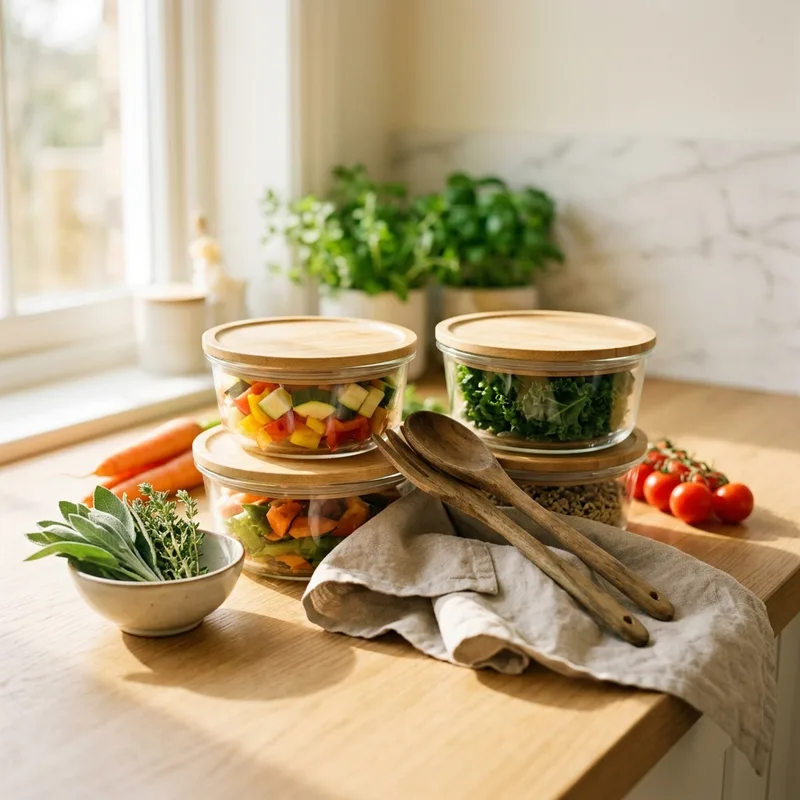
The glass food storage swap, for what it's worth, was the easiest win I ever made: a few sets, bought once, and they simply last for years. If you are tackling the whole kitchen, start with the overview at Food & Kitchen, the plastic cleanout in How to Detox Your Kitchen of Plastic, the foundational Best Non-Toxic Cookware, and, if you still want a nonstick pan, PFAS-free nonstick pans.
A quick, friendly disclosure: some links in our guides are affiliate links, which means we may earn a small commission if you buy through them, at no extra cost to you. It never changes what we recommend or what we would skip.
Safer Swaps
You do not need to toss a working air fryer today. Use what you have, then switch when it is time, in this order:
- Change the habits today. No metal tools, no long empty preheats, no aerosol sprays. Free, and it protects whatever coating you own.
- If your current basket is scratched or peeling, replace it now. A degraded nonstick coating is the one case where I would not wait. Move to a bare stainless replacement basket, a glass model, or a verified PFAS-free ceramic one.
- When you buy next, choose bare stainless or glass if you can live with the cleanup. No coating means no coating to fail, ever. See Best Non-Toxic Air Fryers for models that actually pass the spec check.
- If you want easy release, buy quality PTFE-free ceramic, not the cheapest "ceramic" box. Confirm it in writing, and check Ceramic-Coated Air Fryers first.
The Bottom Line
A non-toxic air fryer comes down to one question: what does the basket touch your food with? If you remember nothing else, remember that bare stainless steel and glass remove the coating question entirely, that a PTFE-free ceramic coating is a reasonable middle path if you want easy cleanup, and that an intact PTFE basket at normal temperatures is low-risk rather than an emergency. Everything labeled "natural" or "eco" is noise until you read the actual material spec.
Your one next step: go look up the food-contact material on the air fryer you own or are about to buy. If it is listed as bare stainless, glass, or verified PTFE-free ceramic, you are in good shape. If the company will not tell you, that is your answer.