Here is the honest version: a ceramic-coated air fryer with a genuine sol-gel coating is usually safer than a Teflon one, because the good ones skip PTFE and PFOA entirely. But "ceramic" is a marketing word, not a legal standard. A box can say ceramic and still hide a fluorinated primer or a vague coating the brand will not name. So the word alone does not earn your money. The PFAS-free claim does.
I avoid Teflon (PTFE) in my own kitchen completely, so I understand the pull of anything labeled "ceramic." It feels like the clean option. Most of the time it is a better option. The trouble is that a label designed to make you feel safe is exactly the label manufacturers learn to game first. This guide unpacks what ceramic coating actually is, how to tell a real PFAS-free claim from a greenwashed one, and four ceramic-coated air fryers with coatings the brands are willing to name.
What "Ceramic Coating" Actually Means
Despite the name, a ceramic air fryer basket is not a slab of pottery. It is usually aluminum or steel sprayed with a thin sol-gel coating: a silica-based (sand-derived) liquid that is heat-cured into a smooth, hard, nonstick surface. That is the real technology behind almost every "ceramic nonstick" product you will see.
The good news is that a true sol-gel coating contains no PTFE and no PFOA, the fluorinated chemicals that define Teflon-style nonstick. That is the whole reason ceramic became the darling of the low-tox kitchen. If you want the full chemistry of why PTFE worries people, we cover it in Is Nonstick Cookware Toxic? and what the heat research actually shows in PFAS in Air Fryers. I will not repeat it here.
The catch: "ceramic" is unregulated. Nothing stops a brand from calling a coating ceramic while the basket still relies on a fluoropolymer layer underneath, or from staying silent about what the coating actually is.
Where Greenwashing Hides
PFAS stands for per- and polyfluoroalkyl substances, a large family of "forever chemicals" that resist breaking down in the body and environment (EPA on PFAS). A coating marketed as ceramic should be free of all of them. Here is how brands blur that line.
- "Ceramic" with no coating name. If the listing never names the actual coating or says "PFAS-free" in plain words, treat it as unproven.
- "PFOA-free" only. PFOA has been phased out of US nonstick for years, so "PFOA-free" is nearly meaningless on its own. It can sit right next to a PTFE coating. You want PFAS-free, which is the broader claim.
- "PTFE-free" without the rest. Better, but still check for PFAS-free language, since PFAS is the whole family.
- "Non-toxic" splashed everywhere. Non-toxic is not a certification. It is a vibe. Look past it for the specifics.
My rule: the brand must name the coating or state PFAS-free in writing. No named coating, no sale. This is the kitchen version of my thirty-second habit with personal care, where I check every new product on an ingredient database before buying. Same instinct, different shelf.
Our Top Picks at a Glance
| Product | Best For | Key Material or Certification | Why It Wins |
|---|---|---|---|
| Cosori TurboBlaze 6 Qt | Best Overall | PFAS-free ceramic coating | Named coating, right size for most families |
| GreenLife Compact Air Fryer 5.3 QT | Best for Small Kitchens | Ceramic nonstick, PFAS-free (per the maker) | Compact and clearly labeled |
| Typhur Sync 8 Qt | Best for Precision Cooking | Global Recycled Standard, meat thermometer | Built-in probe takes the guesswork out |
| nutribullet CrispLite 8 Qt | Best for Bigger Batches | PFAS-free ceramic (per the maker) | Big basket plus a viewing window |
Affiliate disclosure: some links below are affiliate links. If you buy through them, we may earn a small commission at no extra cost to you. It never changes which products we recommend or what we say about them.
Best Overall: Cosori TurboBlaze 6 Qt
The TurboBlaze hits the sweet spot for most households: a 6-quart basket that fits a family dinner without dominating the counter, and a coating Cosori states is PFAS-free ceramic. That named, specific claim is exactly what I want to see before I spend money. Nine functions is more than most people use, but the core air-fry performance is the reason to buy it.
Pros:
- Clearly stated PFAS-free ceramic coating
- 6 Qt suits most families without being bulky
- Strong airflow design for even crisping
Cons: The nine-in-one programming is more than many people will ever touch, and that complexity is baked into the price.

Best for Small Kitchens: GreenLife Compact Air Fryer 5.3 QT
GreenLife is a ceramic-first brand, and its compact air fryer keeps a small footprint while giving you a 5.3-quart drawer. The maker states the ceramic nonstick drawer and crisper are free of PFAS, PFOA, lead and cadmium, which is exactly the wording you want to see rather than a vague "non-toxic" label. It is a sensible first air fryer for one or two people or a small apartment kitchen.
Pros:
- Ceramic nonstick drawer, PFAS-free per the maker
- Compact footprint, simple one-touch presets
- Light enough to store in a cupboard
Cons: 5.3 quarts is comfortable for two but tight for a family meal, and like every ceramic coating it needs gentle tools and hand care to last.

Best for Precision Cooking: Typhur Sync 8 Qt
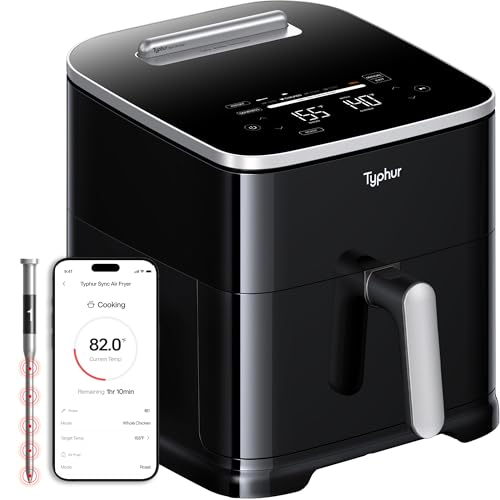
The Typhur Sync is the one for people who hate guessing whether the chicken is done. It has a built-in wireless meat thermometer, so you cook to an internal temperature instead of a timer, which genuinely matters for meat safety. Typhur also cites Global Recycled Standard certification, a sustainability credential that speaks to materials and supply chain transparency rather than coating chemistry specifically.
Pros:
- Built-in wireless probe for cook-to-temperature accuracy
- Large 8 Qt capacity
- Global Recycled Standard certification signals transparency
Cons: It is the premium, tech-forward option here, and the price reflects the smart features. Confirm the basket coating details on the current listing, since GRS is about recycled content, not coating safety.
Best for Bigger Batches: nutribullet CrispLite 8 Qt
For bigger batches, the nutribullet CrispLite gives you an 8-quart basket with a see-through window, and the maker states its ceramic coating is PFAS-free. The window means fewer pull-outs to check on food, and the larger basket handles a full family tray in one round instead of two. If you need even more room, air fryer toaster ovens cook on racks instead of in a basket.
Pros:
- 8-quart basket for family-size batches
- PFAS-free ceramic coating per the maker
- See-through window so you can check food without opening
Cons: It is a large appliance that needs a permanent spot on the counter, and the ceramic coating will not last as long as bare stainless.

How We Chose
We prioritized air fryers whose makers name the coating or state PFAS-free in plain language, not just "ceramic" or "non-toxic." We favored published certifications where they exist and listings transparent about materials. We have not tested these units in our own kitchen, so treat the picks as research-backed shortlists, and always confirm the coating claim on the live listing before you buy, since manufacturers update components.
What Independent Testing Shows About Ceramic
Most of what you read about ceramic coatings comes from the brands selling them, so it is worth knowing what an independent tester found. When Consumer Reports tested nonstick pans for 96 different PFAS, the two ceramic-coated pans contained none of the PFAS on its list, while a PTFE pan sold as PFOA-free still contained traces of PFOA. The experts CR spoke with said ceramic nonstick is unlikely to contain PFAS because the chemicals are not needed to make it.
Two caveats from the same work keep this honest. First, CR calls "PFAS-free" a hard claim to prove, because there are thousands of PFAS and lab panels cover a fraction of them; that is why I treat "PTFE-free" plus a named coating as the meaningful pair of claims. Second, ceramic pans performed about as well as PTFE on evenness and food release in CR's ratings, but some scored lower on durability. That matches what I tell people: ceramic is the cleaner coating, and the basket is a consumable.
How to read a ceramic air fryer listing
| What the listing says | What it likely means | My call |
|---|---|---|
| "Ceramic nonstick, PTFE-free, made without PFAS" | A genuine sol-gel coating, clearly disclosed | Buy with confidence |
| "Ceramic coating" and nothing else | Probably sol-gel, but unproven | Ask the brand before buying |
| "Ceramic-reinforced" or "ceramic-infused" nonstick | Can be a PTFE coating with ceramic particles | Treat as PTFE until told otherwise |
| "PFOA-free nonstick" | Almost always PTFE | Not a ceramic product |
| "Healthy," "non-toxic," "eco" coating | Marketing, no chemistry stated | Skip |
The "ceramic-reinforced" line is the one that catches people: the word ceramic is on the box, but the release layer may still be a fluoropolymer. If the brand will not say "PTFE-free," assume it is not. For what specific brands put on their baskets, see our Gourmia, Ninja and popular-brand coating comparison.
A Named Trade-Off: Ceramic vs Stainless
Ceramic nonstick is easier to cook on and clean, but it has one honest weakness: the coating wears over time. Even the best sol-gel surface is not forever. Stainless steel baskets last far longer but demand more oil and scrubbing. There is no perfect answer, only the trade you prefer. We compare the interior options in full in Non-Toxic Air Fryers: Which Materials and Coatings Are Actually Safe? and make the stainless case in Stainless Steel Air Fryers. If you want zero coating at all, a glass air fryer sidesteps the whole debate.
In my own kitchen I run mostly stainless steel cookware and no Teflon, but I have nothing against ceramic. It is a different, PTFE-free coating, and I would happily use a ceramic basket. The point is simply to know which trade-off you are signing up for.
How to Care for a Ceramic Coating (So It Lasts)
Ceramic does tend to lose its nonstick release sooner than PTFE, and it wears out fastest when you treat it like cast iron. Treated gently, a good coating still lasts years.
- Hand wash, skip the dishwasher. Harsh detergent and high heat dull the coating even when the manual allows it. Warm water and a soft sponge win.
- No metal, no abrasive scrubbers. Use food-grade silicone or wood (I skip nylon, which softens with heat). Our take on wooden utensils and silicone ones covers safe options.
- Avoid aerosol cooking sprays. The propellants and additives build up and gum the surface over time. A light brush of oil is better.
- Let it cool before washing. Thermal shock from cold water on a hot basket stresses any coating.
- Do not preheat empty for long. Dry high heat is hard on nonstick surfaces.
When to Replace It
Retire a ceramic basket when you see visible scratching, chipping, flaking, or spots where food suddenly sticks that never stuck before. A worn coating is not an emergency, but a degraded surface is not doing its job and bits can shed into food. This is where stainless earns its keep: no coating to wear out. Think of ceramic as a consumable with a multi-year lifespan, not a one-time purchase.
Safer Swaps
Use up what you have first. If your current air fryer still works, there is no reason to toss it today. Swap when it wears out or when you are ready.
- Easiest high-impact swap: replace a flaking Teflon basket with a clearly labeled PFAS-free ceramic unit like the Cosori TurboBlaze. You keep the convenience and drop the fluorinated coating.
- Space-limited swap: the GreenLife Compact for small kitchens, with PFAS-free wording on the label.
- Zero-coating swap: go stainless or glass if you never want to replace a coating again. See our non-toxic air fryer roundup and the broader Food & Kitchen hub.
The Bottom Line
Ceramic air fryers are a real step up from Teflon when the coating is a genuine, named, PFAS-free sol-gel. But ceramic is a marketing word, so make the brand prove it. Your one next step: before you check out, read the listing and confirm it says PFAS-free in plain words and names the coating. If it only says "ceramic" or "non-toxic," keep scrolling. That thirty-second check is the whole game.