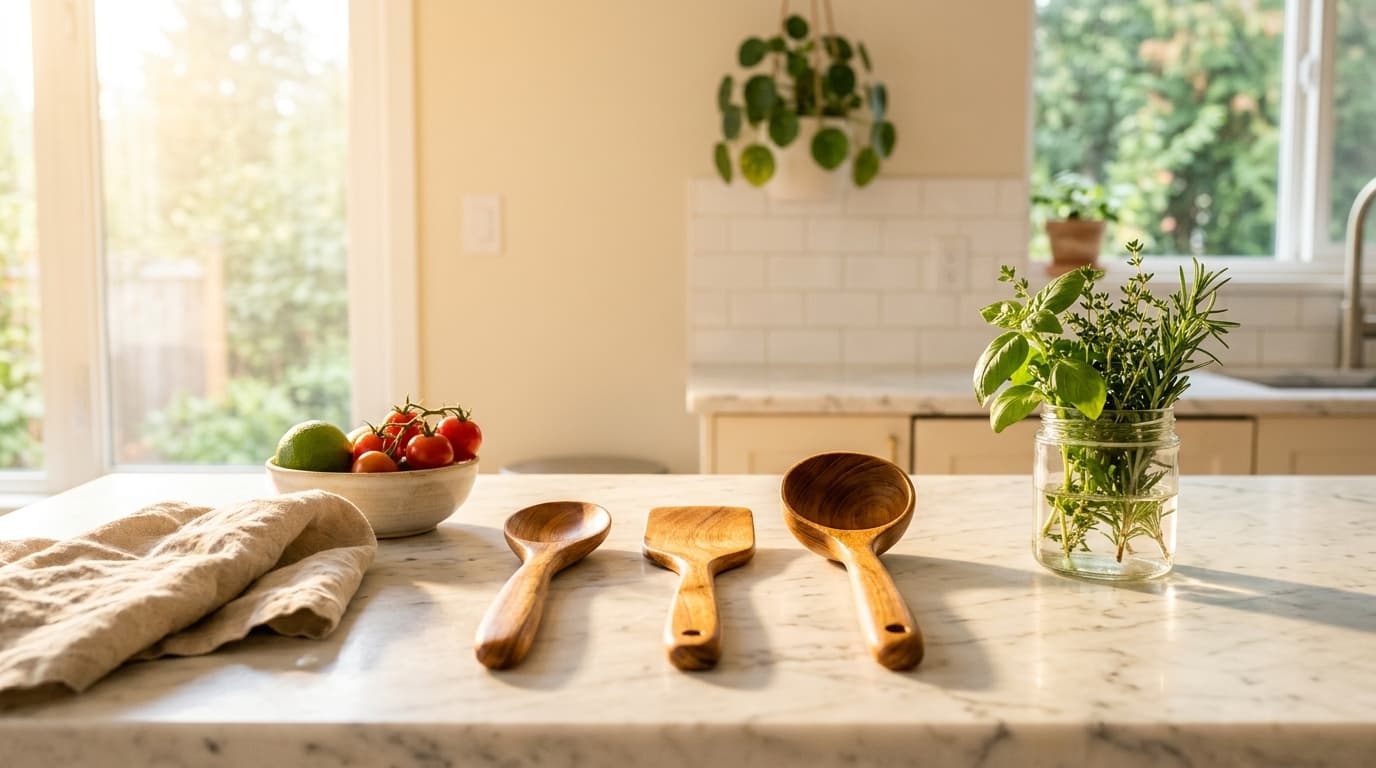
If you want to pull one category of plastic out of your kitchen and feel genuinely good about it, start with your utensils, and make the replacement wood. Solid hardwood utensils have no plastic to leach, no BPA, no PFAS coating to scratch off into your stir-fry. They don't melt against a hot pan. And a well-made wooden spoon lasts years. That is about as clean a material story as you'll find in a kitchen drawer.
The one thing you'll hear as a counterargument is hygiene: isn't wood a germ sponge? It is a fair question, and the honest answer has nuance. Wood is not sterile, and it is not magically "anti-bacterial." But research going back decades shows that properly dried wood is actually quite hostile to the bacteria sitting on its surface, often more so than plastic. Below is the material case, the finishes to avoid, how to care for wood so it stays safe, and the specific sets I'd actually buy.
Affiliate disclosure: some links below are affiliate links. If you buy through them, we may earn a small commission at no extra cost to you. It never changes which products we recommend.
Why Wood Beats Plastic in the Utensil Drawer
Plastic utensils are the easy win in a low-tox kitchen because they stack up badly on every count. Soft plastics can contain phthalates (the chemicals that make plastic flexible) and some contain BPA (a hormone-mimicking chemical used to harden plastic). Black plastic utensils have an added problem: a 2024 study of black plastic household products found flame retardants, likely from recycled electronics plastic, in many kitchen utensils (the authors later corrected their exposure estimate downward, but the contamination itself stands; the NIEHS explains why these chemicals get scrutiny). And every time you drag a plastic spoon across a hot pan, tiny amounts of material shed off, which is exactly the microplastic exposure you're trying to reduce. If plastic is your starting point, our full walkthrough on how to detox your kitchen of plastic covers the order I'd do it in.
Wood sidesteps all of that. It is a single natural material with nothing to leach and no coating to degrade. It is also kinder to your cookware, which matters if you've invested in nicer pans (more on that in our non-toxic cookware guide). Wood is not the only good material, though: our comparison of non-toxic kitchen utensil materials shows where stainless steel and silicone beat it, and what the research says about silicone covers the other soft-on-pans option.
Is Wood Actually Hygienic? The Honest Answer
This is the part most articles get wrong by overpromising. Wood is not anti-bacterial in the sense of killing everything on contact. What the research shows is subtler and more useful: bacteria applied to a dry wooden surface tend to die off, drawn down into the wood where they lose moisture and cannot multiply, while on plastic they survive on the surface and transfer back more easily. The frequently cited work here comes from food microbiologists at the University of California, Davis, who contaminated wooden and plastic cutting boards with bacteria in the lab: on clean, dry wood the bacteria died off quickly, while knife-scarred plastic proved hard to clean and disinfect by hand. Cutting boards are not spoons, but the principle, that dry wood is a poor home for surface bacteria, carries over.
The catch is the word dry. Wet wood is a different story. The protection comes from wood pulling moisture away, so a utensil left sitting in a sink or soaking in a pot works against you. The rule is simple: clean it, dry it, don't soak it.
What Makes a Wooden Utensil Genuinely Low-Tox
Not all "wooden" utensils are equal. Here is what I look for.
Solid hardwood, not bamboo composite
Teak, beech, maple and acacia are dense hardwoods that resist water and hold up to daily cooking. Teak is my favorite because its natural oils make it especially water-resistant. Watch out for "bamboo" utensils that are actually bamboo fiber composite, which means bamboo dust bound together with a resin or glue. Those are a different product entirely, and the binder is exactly the unknown you're trying to avoid.
The finish is where toxins hide
A raw hardwood spoon is inert. The risk, if there is one, comes from what was put on it. Avoid anything coated in an unspecified "lacquer," "varnish" or glossy synthetic finish, because you don't know what's in it and it can chip into food. The gold standard is a utensil finished with nothing but food-safe oil, or sold unfinished so you can oil it yourself. Food-grade mineral oil (sold labeled as food-grade or USP) or a dedicated board oil is what you want; beeswax blends sold for cutting boards work too.
No stain, no glue in the food-contact zone
Skip utensils that are stained a dark color for looks, and be wary of multi-piece construction where a handle is glued to a head. One-piece solid wood is simplest and safest.
Our Top Picks at a Glance
| Product | Best For | Key Material or Certification | Why It Wins |
|---|---|---|---|
| 10-Pc Teak Set | Best Overall | Non-toxic teak, ClimatePartner verified | Most complete set with proven track record |
| 8-Pc Teak Set with Holder | Best for Countertop Storage | Teak, ClimatePartner verified | Includes a holder, keeps utensils dry |
| 6-Pc Teak Set | Best Budget Pick | Natural teak | Lowest cost, same safe material |
| 4-Pc Teak Spatula Set | Best for Nonstick & Ceramic Pans | Teak, ClimatePartner verified | Flat edges made for scratch-free cooking |
Best Overall: 10-Piece Non-Toxic Teak Utensil Set
If you're replacing a whole drawer at once, this is the one I'd point most people to. Ten pieces of solid teak cover essentially every cooking task, and the material is the same inert hardwood across the set with ClimatePartner-verified sustainability credentials, which is a genuine differentiator when most wooden utensils say nothing about sourcing. The large body of long-term buyer feedback is reassuring for a product you'll use daily.
Pros:
- Solid non-toxic teak, no coatings or plastic
- Complete 10-piece range handles most cooking
- ClimatePartner verified sustainability sourcing
- Well-established track record among buyers
Cons: It is the priciest option here, around $40 for the full set, which is more than you'll want to spend if you only want a few basics.

Best for Countertop Storage: 8-Piece Teak Set with Holder
The holder is the smart part of this set. The single best thing you can do for wooden utensils is keep them dry and off the countertop between uses, and a holder does exactly that while keeping them within reach. You get eight teak pieces plus storage for a fair all-in price, again with ClimatePartner verification. For most home cooks, eight pieces is plenty.
Pros:
- Includes a holder that keeps utensils dry and upright
- ClimatePartner verified teak
- Strong value when you factor in the storage
- Consistent quality reputation
Cons: Slightly fewer pieces than the 10-piece set at a similar price, so it's less of a deal if you want maximum variety.

Best Budget Pick: 6-Piece Teak Utensil Set
Here's the honest truth about wooden utensils: the material is the material. Natural teak is just as inert and just as durable in this value set as in the premium ones. For around $20 you get six solid teak pieces, which is enough to cook most meals. If you want to ditch plastic without spending much, start here and add pieces later.
Pros:
- Excellent value for genuinely non-toxic teak
- Six pieces cover the essentials
- Durable, naturally water-resistant wood
Cons: No sustainability certification listed, so if third-party verified sourcing matters to you, the ClimatePartner sets are the better fit.

Best for Nonstick & Ceramic Pans: 4-Piece Teak Spatula Set
Wood is the ideal partner for any coated pan because it won't scratch the surface. This four-piece spatula set is built for exactly that: flat, thin edges that get under food without gouging. We use stainless steel at home and no PTFE (Teflon) at all, but if you cook on ceramic-coated or any nonstick pan, a wooden spatula protects your investment. It earns the highest buyer rating of this group.
Pros:
- Flat edges designed for scratch-free cooking
- ClimatePartner verified teak
- Highest-rated set of the four here
- Safe on ceramic, stainless and nonstick alike
Cons: It's four spatulas with no spoons or slotted tools, so it's a complement to a fuller set, not a standalone drawer.

How We Chose
We prioritized utensils made from a single solid hardwood (teak across all four picks) with no synthetic lacquers, stains or composite binders in the food-contact zone. Where available, we favored third-party sustainability verification like ClimatePartner. We do not test products hands-on; these picks reflect our low-tox material criteria, the transparency of what each product is made from, and the consistency of long-term buyer feedback.
Which Wood? A Quick Comparison
| Wood | Why people choose it | Watch for |
|---|---|---|
| Teak | Natural oils make it very water-resistant; low maintenance | Check the finish is oil only, not lacquer |
| Maple and beech | Dense, tight-grained, classic spoon woods | Need regular oiling; can stain with turmeric and tomato |
| Olive wood | Very dense and hard, attractive grain | Usually pricier; cracks if left soaking |
| Acacia | Durable and affordable | Often sold with a glossy finish; choose oiled |
| Solid bamboo | Light, hard, fast-growing grass | Laminated or "bamboo fiber" pieces rely on glue or resin |
Whichever wood you pick, the rules from above matter more than the species: one solid piece, no unspecified lacquer or stain, and a food-safe oil finish.
How to Season and Care for Wooden Utensils
This is what keeps a wooden utensil safe and lasting for years, and it takes minutes.
Season new utensils before first use
Rub a thin coat of food-grade mineral oil (or a dedicated cutting-board oil) over the whole piece, let it soak in for a few hours or overnight, then wipe off the excess. This fills the wood's pores so it absorbs less water during cooking. Re-oil every month or two, or whenever the wood looks dry and pale.
Wash by hand, never the dishwasher
The dishwasher's heat, prolonged soaking and harsh detergent will crack and warp wood fast. Wash by hand with warm water and a plant-based dish soap, rinse, and dry promptly. A cloth beats leaving them in a drying rack to pool water.
Deep-clean without bleach
For a smelly or heavily used utensil, scrub with coarse salt and a cut lemon, rinse, dry fully, then re-oil. That's gentler than bleach and does the job.
When to Replace a Wooden Utensil
Wood is durable, not immortal. Replace a utensil when you see deep cracks or splits (water and food get trapped where you can't clean them), when the surface stays rough and fuzzy even after oiling, or when any glued joint loosens. A smooth, oiled, intact spoon is doing its job; a splitting, grey, dried-out one is past it.
What About Everything Else in the Drawer?
Wood is one great material, not the only one. Food-grade stainless steel and genuinely food-grade silicone both have a place, and each has its own trade-offs worth understanding before you buy. For the full comparison across materials, see our guide to the best non-toxic kitchen utensils, and if you're weighing silicone specifically, read whether silicone utensils are really non-toxic. If you cook in an air fryer, wood or silicone-tipped tongs are also the kindest tools for a coated basket; our non-toxic air fryer guide covers the basket side. For the bigger plastic picture across the whole kitchen, start with Food & Kitchen.
The Bottom Line
Wooden utensils are one of the cleanest, lowest-risk swaps you can make: solid hardwood, no BPA, no PFAS, no melting plastic, and real hygiene performance as long as you keep them dry. The "wood is a germ sponge" worry only holds for wet, neglected wood; dry, oiled wood takes care of itself.
Your one next step: pick a set that matches how much you cook. If you want everything handled, the 10-piece teak set is the complete answer; if you just want to get plastic out of the drawer affordably, the 6-piece set does it for around $20. Use up what plastic you already have if it still works, then make wood the thing you reach for.