You do not need to empty your cabinets into a trash bag this weekend. The highest-impact move to detox kitchen plastic is simple: stop letting plastic meet hot, oily or acidic food. That means the containers you microwave, the tubs you pour hot leftovers into, and the plastic spatula you leave resting in a sizzling pan. Fix those first. Everything else can wait until it wears out.
Here is the honest version nobody tells you: when I first saw how much plastic lived in my kitchen, I wanted to replace all of it at once. It got expensive fast, and in a house with a husband and kids you cannot just bin everyone's favourite things. So I learned to change what was clearly mine, start with the swaps that actually matter, and let the rest happen gradually as things ran out. That is the plan I am going to walk you through.
Why heat and fat are the real issue
Plastic is not one villain molecule. The concern is that certain plastics can shed small amounts of their chemical building blocks into food, and two conditions make that more likely: heat and fat. Warm, oily or acidic food in contact with plastic is simply the scenario where migration is highest.
Two groups of chemicals get the most attention. Bisphenols (BPA and its cousins) are used to harden some plastics and line some cans. Phthalates, the chemicals that make plastics soft and flexible, show up in some food-contact materials too. The U.S. FDA regulates food-contact substances, and research from the National Institute of Environmental Health Sciences shows these compounds can act as endocrine disruptors, meaning they can interfere with the body's hormone signalling. The evidence is about exposure over time, not a single reheated lunch. So this is not a reason to panic. It is a reason to cut the easy exposures you can control, especially the hot ones.
If you want the deeper science on why small, repeated exposures add up, we cover it in The Toxic Buildup Effect. For the specifics on containers, bisphenols and microplastics, see Are Plastic Food Containers Safe?.
The priority order (what to swap first)
Not all kitchen plastic carries the same risk. Here is how I rank it, by how much it matters versus how easy it is to change.
| Priority | Item | Why it ranks here |
|---|---|---|
| 1 | Plastic you microwave or pour hot food into | Heat drives migration; highest payoff |
| 2 | Everyday leftover and freezer storage | Long contact time, often oily or acidic food |
| 3 | Cooking utensils that touch hot pans | Direct heat, some melt or scar |
| 4 | Cutting boards, mixing bowls, measuring cups | Mostly cold contact, lower urgency |
| 5 | Water bottles and sippy cups | Matters, but a smaller food-contact surface |
The rule behind the ranking: the hotter the food and the longer the contact, the sooner you swap it. A plastic colander you rinse cold lettuce in is low on the list. The container you reheat spaghetti in five times a week is at the top.
Step 1: Stop heating food in plastic (today, free)
This first step costs nothing and is the single most effective thing you will do. Never microwave food in plastic, even if it says "microwave safe." That label means the container will not warp, not that nothing migrates into your food. Transfer leftovers to a glass bowl or a plate before reheating.
While you are at it, stop pouring hot soup, sauce or cooked rice straight into plastic tubs to cool. Let food cool in the pot or a glass bowl, then store it. These two habits change your biggest exposure before you spend a single dollar.
Step 2: Switch food storage to glass (the easy win)
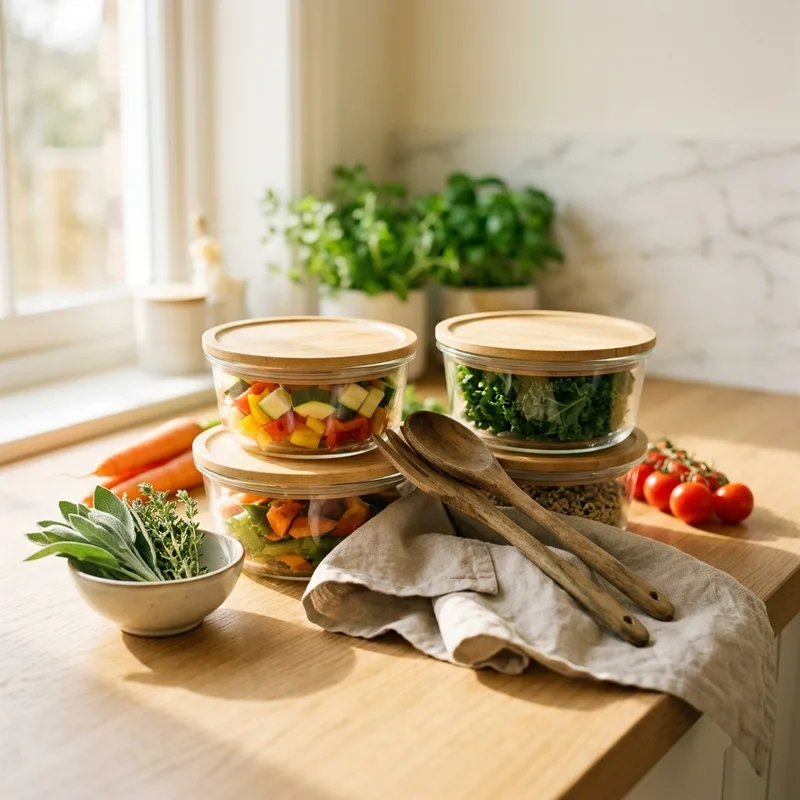
This was the swap that genuinely surprised me with how painless it was. Glass food storage is affordable, it lasts for years, and you only need a few sets to cover most of what a family uses. Mine have been going strong without drama. If one thing on this whole list is almost too easy, it is this.
You do not need to buy a 20-piece set on day one. Start with the sizes you reach for most: a couple of mediums for leftovers, one large for batch cooking. Use up your plastic tubs for dry goods or non-food storage (crayons, hardware, craft bits live beautifully in old containers) so nothing gets wasted.
One honest trade-off: glass is heavier and it can break. If you have small kids plating their own snacks, keep a few shatter-resistant or stainless options in the low cupboard they can reach, and put glass up higher. For the full rundown of sets worth buying and the lid materials to look for, see Best Glass Food Storage Containers.
Step 3: Replace plastic utensils that touch heat
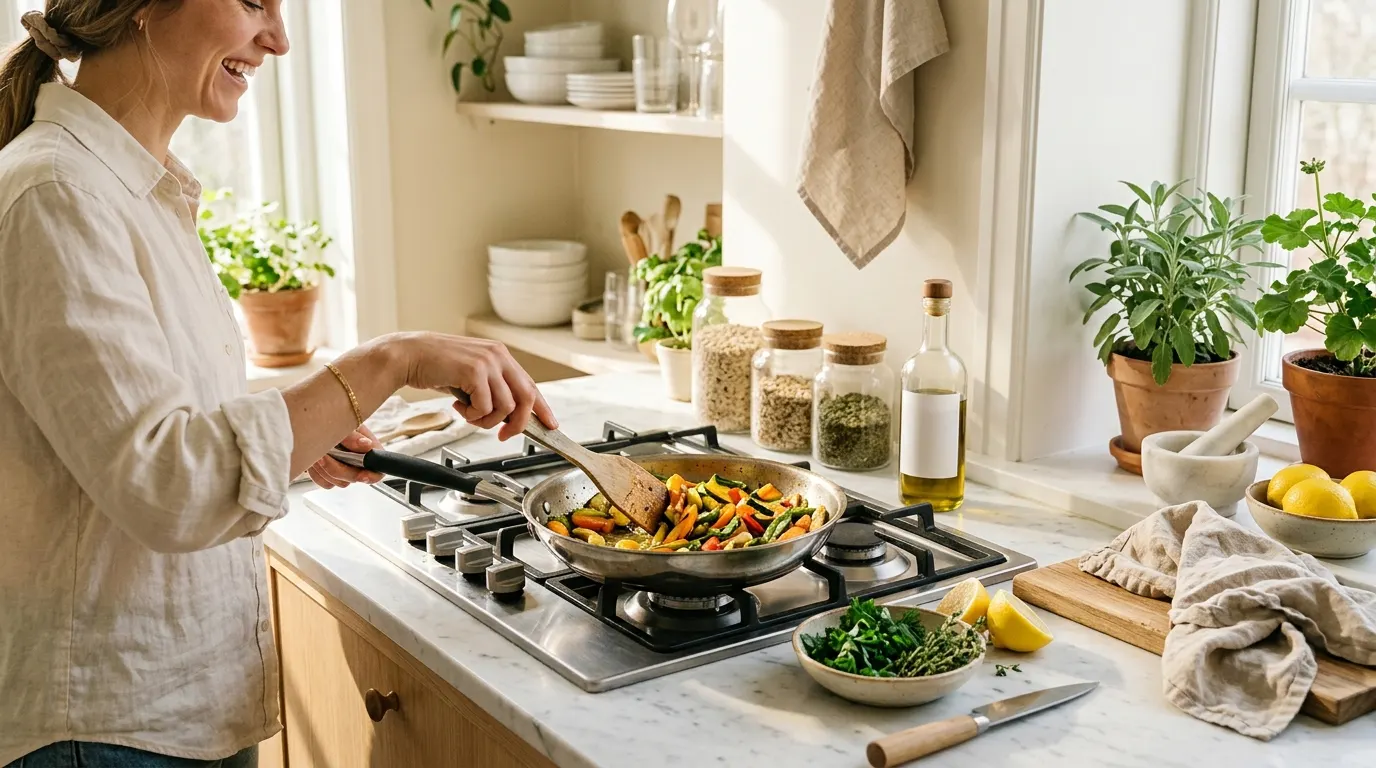
The black plastic spatula melting slightly at the edge is a classic. Cooking utensils sit in hot, oily pans, which is exactly the heat-plus-fat combination you want to avoid. These are cheap to replace and the swap is satisfying.
Go for stainless steel, solid wood or bamboo for stirring, flipping and serving. Silicone is a reasonable middle ground for anything that touches nonstick surfaces: food-grade silicone is stable at normal cooking temperatures and does not scratch coatings. I would skip the cheapest no-name silicone and buy a known brand; the pinch test and heat limits are explained in are silicone kitchen utensils really non-toxic?, and the full material comparison is in best non-toxic kitchen utensils.
Use up what you have logic applies here too, with one exception: if a plastic utensil is already warped, scarred or melting, retire it now. It is not doing its job and it is shedding into your food.
Step 4: Rethink wrap, bags and the small stuff
Cling film and zip bags are the sneaky ones because they are cheap and convenient. You do not have to go cold turkey. A few swaps that stick:
- Beeswax wraps or a plate on top of a bowl instead of cling film for fridge storage.
- Silicone stasher-style bags or glass jars for freezing, instead of single-use zip bags.
- Glass jars (reuse your pasta sauce jars) for dry goods, broth and leftovers.
Cold contact and short contact time make these lower priority than your reheating habits, so do not stress about them until the bigger swaps are done.
Step 5: Cookware, bakeware and water (link, do not duplicate)
Cookware is not plastic, but it is where people's "detox the kitchen" questions usually go next, so a quick map. Nonstick pans are their own topic because the concern there is PFAS, a family of coatings, not plasticizers: see Is Nonstick Cookware Toxic?. In our home, cookware is mostly stainless steel with no nonstick, and if you are weighing materials, Ceramic vs Stainless Steel Cookware and Best Non-Toxic Cookware go deep.
For bakeware, skip the deep dive here and read Best Non-Toxic Bakeware. And if drinking water is on your list, a filter does more for everyday exposure than most kitchen swaps: Best Non-Toxic Water Filter for Home.
The family reality: change what is yours first
Here is where plans meet real houses. You can control your own habits and the shared items you are responsible for, like storage containers and cooking utensils. You cannot, and should not, confiscate your kid's favourite plastic cup or override your partner's choices.
In my house, I change what is clearly mine, and I accept that everyone else makes their own calls. Free will applies to the whole family, not just the person reading low-tox articles. Sometimes a swap just does not land: someone says "this isn't as good," and we go back for now. That is fine. It is not failure, it is a household of actual people.
The practical move with kids: give them a dedicated low cabinet with a few safe, shatter-resistant plates and cups they are allowed to grab. You control what goes in it, they get their independence. For options built for small hands, see Best Non-Toxic Kids Plates & Utensils. The bigger picture of changing a family's habits without a fight lives in Children and Family.
What this costs (and where to save)
The expensive myth is that going plastic-free means a giant one-time bill. It does not, if you phase it.
The one-time cost of good glass storage and a set of stainless or wood utensils is modest and these things last for years, which makes the per-year cost tiny. The way to overspend is to replace everything in one panicked weekend, which is exactly the mistake I made early on. If budget is the main constraint, work the priority table top to bottom and buy one tier at a time as money allows. We have a whole framework for this in Toxin-Free on a Budget.
A quick word on "BPA-free" labels
"BPA-free" is doing a lot of marketing work. It tells you one specific chemical is absent. It does not tell you what replaced it, and some BPA substitutes have raised similar questions in research. I do not treat "BPA-free" as a green light to microwave plastic. I treat it as a slightly-better plastic that still should not meet hot food. If you want to get fluent in reading these claims and the ingredient names behind them, Decoding Product Labels is the place to start.
Safer Swaps
Work these in order. Use up what you have before you replace it, with the one exception of anything melted, scarred or warped.
- Stop heating food in plastic (free, today). Reheat in glass or on a plate; cool hot food in the pot before storing. This is the highest-impact change and it costs nothing.
- Move leftovers to glass storage. Start with the two or three sizes you use most and expand as your plastic tubs retire to the garage or craft drawer. Full picks: Best Glass Food Storage Containers.
- Replace heat-contact utensils with stainless, wood or food-grade silicone. Cheap, quick, and it gets plastic out of your hottest pans. For the cookware those utensils live in, see The Non-Toxic Kitchen complete guide.
The Bottom Line
You do not detox your kitchen of plastic by throwing it all out. You do it by never again putting hot food in contact with plastic, then swapping storage and heat-contact utensils for glass, stainless and wood as your old stuff wears out. Change what is yours, let the family come along at their own pace, and let the easiest, highest-impact habit carry most of the benefit.
Your one next step: tonight, when there are leftovers, reach for a glass bowl or a plate to reheat instead of the plastic tub. That single habit, repeated, is most of the win. For the full kitchen picture including cookware and water, start with The Non-Toxic Kitchen complete guide.