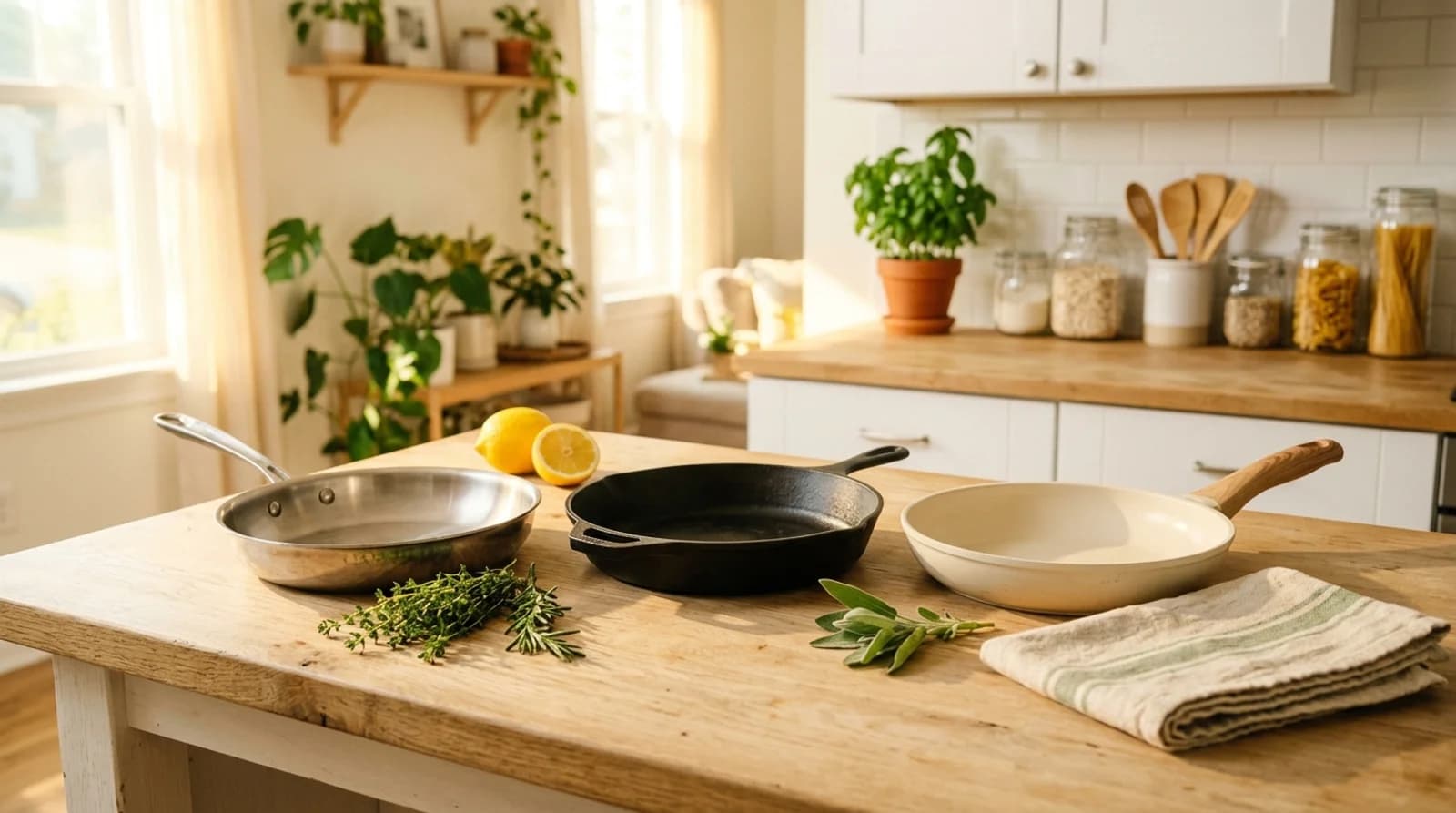
Here is the short version: for most kitchens, the best non-toxic cookware is tri-ply stainless steel. There is no coating to scratch, flake or degrade, and it lasts for decades. It is not perfectly inert (more on nickel below), but it is the most durable low-tox choice. Ceramic-coated pans are the easy-release option if you cook with little fat, but be realistic: that slick surface wears out in a few years, not forever. Cast iron is the heavyweight champion for searing and high heat. None of them are "detox" magic. They are just honest materials.
I will be straight with you about something before we go further. In our home the cookware is mostly stainless steel, with no non-stick at all. That is my personal choice, and it is not the only right answer. Plenty of people happily cook on ceramic-coated pans and swap them out when they wear down. This guide compares all three so you can match the cookware to how you actually cook, not to how a marketing page says you should.
What Makes Cookware Genuinely Non-Toxic
The concern with cookware is what can migrate from the pan into your food, and that comes down to the material and any coating on top of it.
The classic worry is PFAS, the group of "forever chemicals" used in traditional non-stick coatings like PTFE (the stuff often called by the brand name Teflon). These are called forever chemicals because they break down extremely slowly in the environment and the body. The EPA explains PFAS and why they persist clearly. Overheated traditional non-stick can release fumes, and scratched coatings shed particles. If you want the full breakdown of that, read Is Nonstick Cookware Toxic? (PFAS & Teflon Explained). Here, I will keep it to the safer materials.
A genuinely low-tox pan is one of three things:
- Bare metal with no coating: stainless steel or cast iron. Nothing to degrade.
- Mineral-based ceramic coating: a silica-based layer (sol-gel) with no PTFE or other PFAS. It is non-toxic while intact, but it is not permanent.
- Enameled cast iron: cast iron with a glass-based enamel coating, non-reactive and durable.
What to avoid: the vague label. "Non-toxic" and "healthy" are not regulated terms. Look for an explicit statement that the pan is PFAS, PTFE, PFOA and PFOS free, not just "PFOA free" (PFOA was already phased out, so that claim alone tells you little).
Ceramic vs Cast Iron vs Stainless: The Honest Trade-Offs
There is no single winner. There is a winner for your cooking style. Here is how I think about it.
| Material | Best at | The honest downside | Lifespan |
|---|---|---|---|
| Stainless steel (tri-ply) | Everything: searing, sauces, browning, acidic foods | Food sticks until you learn the heat-and-fat trick; heavier | Decades |
| Ceramic-coated | Eggs, low-fat cooking, easy cleanup, beginners | Non-stick effect fades with use | A few years |
| Cast iron | High-heat searing, cornbread, heat retention | Heavy, needs seasoning, not for delicate acidic sauces | Generations |
The one people get wrong most often is ceramic. The pans are real and non-toxic, but the slick coating is a consumable, like a razor blade, not a lifetime investment. If a listing implies the non-stick lasts forever, that is marketing, not physics. For a deeper side-by-side on the two most popular choices, see Ceramic vs Stainless Steel Cookware: Which Is Safer?.
Our Top Picks at a Glance
These are the sets that meet the low-tox bar: bare stainless, or ceramic coatings whose makers explicitly state PFAS-free.
| Product | Best For | Key Material or Certification | Why It Wins |
|---|---|---|---|
| Cuisinart MultiClad Pro 12-Piece | Best Overall | Tri-ply stainless steel, no coating | Nothing to degrade, lasts decades |
| CAROTE 21pcs Ceramic Set | Best Big Starter Set | PFAS-free ceramic (per maker) | Full kitchen outfit at a gentle price |
| SENSARTE 14-Piece Ceramic | Best for Induction | PFAS/PTFE/PFOA/PFOS free | Explicit full disclosure, induction ready |
| CAROTE 25pcs Detachable Handle | Best for Small Kitchens | PFAS-free ceramic (per maker), detachable handles | Stacks small, goes oven-to-table |
Best Overall: Cuisinart MultiClad Pro 12-Piece Stainless Steel
This is the one I would buy if I were starting over, and it is the material our own kitchen runs on. Tri-ply stainless (a layer of aluminum sandwiched between stainless steel) heats evenly and has no coating at all, which means nothing to scratch, flake or replace. It is the closest thing to a buy-it-once decision in cookware.
Pros:
- Bare stainless with no coating to degrade
- Tri-ply construction heats evenly and browns beautifully
- Oven and broiler safe, dishwasher friendly
- Realistically lasts for decades
Cons: Like all 18/10 stainless, it contains nickel, and new pans release a little nickel and chromium into acidic, long-simmered food; the amount drops as the pan is used, but if you have a nickel allergy, read Ceramic vs Stainless Steel Cookware first. There is also a learning curve. Food sticks until you learn to preheat the pan and add fat before the food (the water-droplet test helps). It is also heavier and pricier than ceramic. This is a premium, long-term investment, not the cheapest way to start.

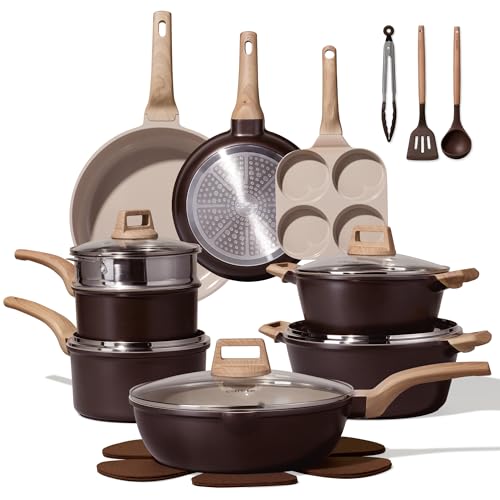
Best Big Starter Set: CAROTE 21pcs Ceramic Cookware Set
If you want to outfit a whole kitchen at once with easy-release pans, this large ceramic set does it affordably. CAROTE lists the coating as PFAS-free (which covers PTFE), so it clears the low-tox bar, and the non-stick surface makes it forgiving for anyone moving away from traditional Teflon pans for the first time.
Pros:
- PFAS-free ceramic coating, per the maker
- A complete kitchen outfit in one purchase
- Easy release and easy cleanup, great for beginners
- Reasonably priced for the number of pieces
Cons: Twenty-one pieces is a lot. Some of it may sit in the cupboard unused, and like all ceramic, the non-stick effect fades over a few years of regular use. Treat it as a consumable, not a forever set.
Best for Induction: SENSARTE 14-Piece Ceramic Cookware
This is the ceramic set I point induction-stove owners to, because it is both induction compatible and the most transparent on the label: explicitly PFAS, PTFE, PFOA and PFOS free. That full list is exactly the kind of disclosure I like to see rather than a vague "non-toxic" stamp.
Pros:
- Explicitly PFAS/PTFE/PFOA/PFOS free
- Induction compatible
- Accessible price point
- A sensibly sized set, not overwhelming
Cons: Same honest caveat as any ceramic: the coating degrades faster than stainless or cast iron under heavy daily use and high heat. Keep it to medium heat and skip metal utensils to stretch its life.

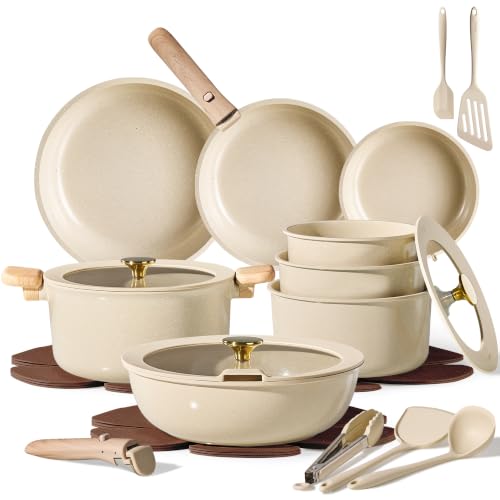
Best for Small Kitchens: CAROTE 25pcs Detachable Handle Set
The detachable handle is the clever part here. The pans stack tightly for storage and go straight from stovetop to oven to table without a bulky handle in the way, which is genuinely useful if cupboard space is tight. The listing describes the ceramic coating as PFAS-free. The detachable handle itself is a separate part (typically plastic), so take it off before the pan goes in the oven.
Pros:
- Detachable handles save serious storage space
- Oven-to-table versatility
- PFAS-free ceramic coating, per the maker
- Flexible, modular set
Cons: Any mechanical handle can loosen over time with repeated clicking on and off, so check the fit before lifting a full, hot pan. And the ceramic coating has the usual finite lifespan.
How We Chose
We vetted on materials and transparency, not hype. Every pick is either bare stainless steel with no coating, or a ceramic coating the maker explicitly states is PFAS-free rather than a vague "healthy" claim. We did not cook on these in a lab, and we never quote star counts or prices, which go stale and which Amazon only allows live through its own system. What we look for is the same thing you should: honest material disclosure and a realistic sense of how long the surface will last.
The Decision Rule: Match the Pan to the Pan's Job
Here is the shortcut I actually use. Do not buy one material for everything. Build a small mix:
- A stainless skillet and a stainless saucepan as your workhorses. These do 80% of cooking and last forever.
- One ceramic-coated pan kept for eggs and anything delicate, accepted as something you will replace every couple of years.
- Optional: one cast iron pan if you sear steaks or bake cornbread (baking dishes get their own guide in best non-toxic bakeware).
That combination is cheaper than a giant single-material set, and it plays to each material's strength. You do not need a 25-piece anything.
Caring for Non-Toxic Cookware (So It Actually Lasts)
Stainless: Preheat, then add fat, then food. Deglaze stuck bits with water or stock. A little [Bar Keepers Friend] style stainless cleaner brings back the shine; stainless is nearly indestructible.
Ceramic: This is where lifespan is won or lost. Keep heat at medium or below (high heat kills ceramic coatings fastest), use wooden or silicone utensils, let pans cool before washing, and hand wash even if the label says dishwasher safe. Done right, you stretch years out of it. Done wrong, months.
Cast iron: Season it, dry it fully, avoid long-simmered acidic sauces that strip the seasoning.
One realistic note the glossy listings skip: no cookware removes all exposure, and cookware is only one piece of a lower-tox kitchen. Your food storage and drinking water matter just as much. If you are tackling the whole room, start with the big map in The Non-Toxic Kitchen: Complete Guide, and remember that the easiest win of all in our kitchen was not a pan at all: it was swapping plastic for glass food storage, a cheap one-time change.
When To Replace (and When Not To)
Please do not throw out a working pan to feel virtuous. Use it up, then switch. The exception is traditional non-stick that is visibly scratched, chipped or flaking: that coating is now ending up in your food, and it is worth retiring. A sound stainless or cast iron pan can serve the next generation. A ceramic pan is done when food starts sticking no matter how much fat you add; that is the coating telling you its job is over.
When you do shop, read the actual ingredient and material claims the way you would a skincare label. If a page says only "non-toxic" with nothing specific behind it, I treat that like any other unverified marketing word. For more on seeing through vague labels, see Decoding Product Labels. The same reading applies to the coated basket in an air fryer, which I compare by material in best non-toxic air fryers: stainless steel, ceramic and glass.
The Bottom Line
If you buy one thing, make it a tri-ply stainless steel skillet. It is the most honestly non-toxic cookware there is: no coating, no wear-out, no asterisk, and it will outlast nearly everything else in your kitchen. Add a single PFAS-free ceramic pan for eggs if you like easy release, and accept from day one that you will replace it in a few years. That is not a flaw in the product; it is just what ceramic is.
Your next step: look at what you cook most this week. If it is eggs and quick sautés, a ceramic pan earns its place. If it is searing, sauces and everyday dinners, start with stainless and learn the heat-and-fat trick. Either way, finish what you own before you swap.