A genuinely PFAS-free nonstick pan is almost always a ceramic-coated pan, meaning a mineral (sol-gel) surface rather than the PTFE film most people picture when they hear "nonstick." The way you verify it is simple and a little boring: the maker has to state plainly that the pan is free of PFOA, PFAS and PTFE. A logo is not proof. In particular, the Recycled Claim Standard (RCS) you will see on some listings is not a PFAS certification at all.
That last point matters, because plenty of listings lean on RCS as if it told you something about safety. It does not. RCS verifies how much recycled material went into a product. It says nothing about whether the coating contains fluorinated chemicals. Below I will walk you through what actually confirms "PFAS-free," which pans are worth buying, and the honest trade-off nobody likes to admit: ceramic nonstick does not last forever. I will also tell you what I chose for my own kitchen instead, because it is not any of these.
What "PFAS-Free" Actually Means on a Pan
PFAS stands for per- and polyfluoroalkyl substances, a large family of chemicals valued for being slippery and heat-stable, which is exactly why they ended up in traditional nonstick coatings. PTFE (the Teflon-type surface) is one of them. PFOA was a processing chemical phased out of US cookware years ago. The EPA's PFAS overview explains why this whole family gets attention: many of these compounds are persistent and widespread in the environment.
For a pan to be meaningfully "PFAS-free," the nonstick surface itself has to be made without fluorinated chemistry. In practice that means a ceramic coating. So the shortcut on a product page is this: if it says ceramic, PFOA-free, PFAS-free and PTFE-free, you are in the right territory. If it only says "PFOA-free," that is a weaker claim, because a pan can be PFOA-free and still be a PTFE pan. I dig into the difference in Is Nonstick Cookware Toxic?.
The RCS Myth: Why a Recycled Logo Is Not Safety Proof
Here is the myth in plain terms. Some ceramic pans are labeled "Recycled Claim Standard Blended." That standard verifies recycled input in the product, nothing more. It is an environmental supply-chain claim, not a chemical-safety one.
So when a listing pairs "PFAS-free" with "Recycled Claim Standard," those are two separate statements. The PFAS-free part is what you care about for your food; the RCS part is a sustainability footnote. Treat them separately. Do not read RCS as confirmation that a pan is free of PFAS. For how marketing language slides past shoppers, see Decoding Product Labels.
What to Look For Before You Buy
Run any nonstick pan through this quick check:
- The word ceramic describing the coating (not just "nonstick").
- Explicit PFOA, PFAS and PTFE free wording from the manufacturer.
- An oven-safe temperature and a note on induction compatibility if your stove needs it.
- Honesty about care: ceramic wants low to medium heat, soft utensils and no abrasive scrubbing.
What does not belong on your checklist: review counts, star ratings, recycled-content logos, or the word "healthy" on its own. "Healthy" is marketing. The coating chemistry is the fact.
Our Top Picks at a Glance
| Product | Best For | Key Material or Certification | Why It Wins |
|---|---|---|---|
| CAROTE 10" Ceramic Skillet | Best Overall Everyday Pan | Ceramic, PFOA/PFAS-free | Workhorse 10" size at an accessible price |
| SENSARTE 9.5" Ceramic Pan | Best for Eggs & Small Jobs | Ceramic, PFAS-free | Perfect omelet size, budget-friendly |
| SENSARTE 12" Deep Pan with Lid | Best for Family Meals | Ceramic, PFOA/PFAS/PTFE-free | Big 5QT capacity plus a lid |
| OXO 8" + 10" Set | Best Two-Pan Starter Set | Ceramic, PFAS-free | Oven-safe, stay-cool handles, two sizes |
Best Overall: CAROTE 10" Ceramic Skillet
If you want one honest everyday nonstick and nothing fancy, the 10-inch CAROTE is the sensible pick. It is an explicitly PFOA/PFAS-free ceramic coating at a price that does not make you flinch, and 10 inches is the size most people reach for first: eggs, a quick sear, a single-person stir-fry. It is induction-compatible, which trips up a lot of ceramic pans.
Pros:
- Explicit PFOA/PFAS-free ceramic coating
- Versatile 10" everyday size
- Induction-compatible
- Accessible price
Cons: Like all ceramic nonstick, the coating is shorter-lived than bare stainless steel and needs gentle care to last.
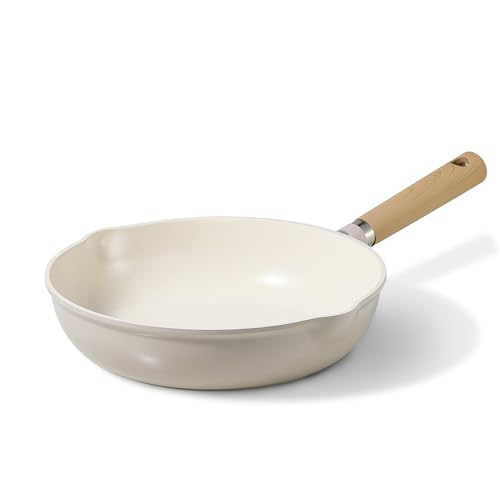
Best for Eggs and Small Jobs: SENSARTE 9.5" Ceramic Pan
The 9.5-inch SENSARTE is the one I would hand someone who mostly wants a dedicated egg and omelet pan. It is PFAS-free ceramic, induction-compatible, and priced as a true budget option. The smaller surface heats fast and is easy to maneuver for a single serving.
Pros:
- PFAS-free ceramic coating
- Ideal size for eggs and omelets
- Induction-compatible
- Budget-friendly
Cons: At 9.5 inches it is too small to be your only pan if you cook for a family.

Best for Family Meals: SENSARTE 12" Deep Pan with Lid
When you are feeding a household, capacity wins. This 12-inch, 5-quart deep SENSARTE doubles as a saute pan, and it is labeled PFOA, PFAS and PTFE free. The helper handle and included lid make it genuinely useful for one-pan dinners. Note the "Recycled Claim Standard Blended" wording in the listing refers to recycled content, not the PFAS status, which is stated separately.
Pros:
- Large 12" / 5QT capacity for family cooking
- PFOA/PFAS/PTFE-free ceramic
- Includes a lid and helper handle
- Induction-compatible
Cons: It costs more than a basic skillet (expect the higher end of the ceramic range), and the lid adds storage bulk.

Best Two-Pan Starter Set: OXO 8" + 10" Ceramic Set
If you are outfitting a kitchen from scratch, the OXO set covers two sizes in one buy: an 8-inch for eggs and an 10-inch for everything else. Both are PFAS-free ceramic, oven-safe, and have stay-cool silicone handles, which is a small comfort you notice every day. It is the premium pick here.
Pros:
- Two useful sizes in one set
- PFAS-free ceramic coating
- Oven-safe with stay-cool silicone handles
- Dishwasher-safe per the maker
Cons: The steepest entry on this list, so less appealing if you only need one pan.

How We Chose
We vetted these on the facts that matter for low-tox cooking: a ceramic (non-PTFE) coating, explicit manufacturer wording that the pan is PFOA/PFAS-free, and clear care and temperature guidance. We did not test these pans in our own kitchen, and we ignore star ratings and review counts because those tell you about popularity, not chemistry. Transparency from the maker is the filter.
The Honest Trade-Off: Ceramic Coatings Wear Out
Here is the part the glossy listings skip. Ceramic nonstick is real and it is a legitimate PFAS-free choice, but it does not last like steel or cast iron. The slickness fades with use, and much sooner if the pan sees high heat, metal utensils or the dishwasher. That is not a defect; it is the nature of a thin mineral coating.
So a ceramic pan is a consumable, not an heirloom. If you buy one, treat it kindly: medium heat, a little fat in the pan, food-grade silicone or wood utensils, hand washing, and no cold water onto a hot surface. Do that and you will get the top of that range. Abuse it and you will be back here in a year.
Why I Chose Stainless Steel Instead
I will be straight with you, because that is the point of this site: in my own kitchen there is no Teflon at all, I skipped nonstick coatings entirely and went with stainless steel. My cookware is mostly stainless, no non-stick, and it is one of the swaps I am happiest with. The reason is exactly the trade-off above. I did not want a surface I would be replacing every couple of years, and stainless has no coating to wear off, scratch or worry about.
Stainless has a learning curve: you preheat the pan, add fat, and let food release on its own instead of forcing it. Eggs are the one place a slick surface genuinely earns its keep, which is why plenty of low-tox kitchens keep a single ceramic pan for eggs and use stainless for everything else. That is a perfectly good setup. I compare the two in Ceramic vs Stainless Steel Cookware, and cookware gets a fuller treatment in Best Non-Toxic Cookware.
Where a PFAS-Free Pan Fits in a Low-Tox Kitchen
Cookware is one piece. If you are working through the kitchen gradually, two of the easiest, highest-value swaps are food storage and drinking water. Glass storage was the single easiest change I made: a few sets, bought once, and they simply last. See Best Glass Food Storage Containers and, for the bigger picture, The Non-Toxic Kitchen.
The same coating trade-off applies to air fryers, which often use a ceramic-coated basket as their PFAS-free option. The wear rules are identical: gentle heat, no metal tools, hand washing. See ceramic-coated air fryers: safer than Teflon, but not all coatings are equal.
And a reminder from the editorial line I hold myself to: do not throw out a pan that still works. If your current nonstick is intact and you are cooking at moderate heat, use it up, then switch. One swap beats no swap, and panic-replacing an entire cabinet is expensive and unnecessary. If budget is tight, read Toxin-Free on a Budget.
The Bottom Line
If you want a PFAS-free nonstick pan, buy a ceramic one that plainly states PFOA/PFAS/PTFE-free, and ignore any Recycled Claim Standard logo as safety proof, because it only tracks recycled content. For most people the CAROTE 10" ceramic skillet is the sensible single-pan choice.
Your one next step: decide whether you want a slick surface you will need to replace every few years, or a coating-free pan you keep for decades. If it is the former, pick one ceramic pan from the list above and treat it gently. If it is the latter, let your current nonstick finish its life, then move to stainless.