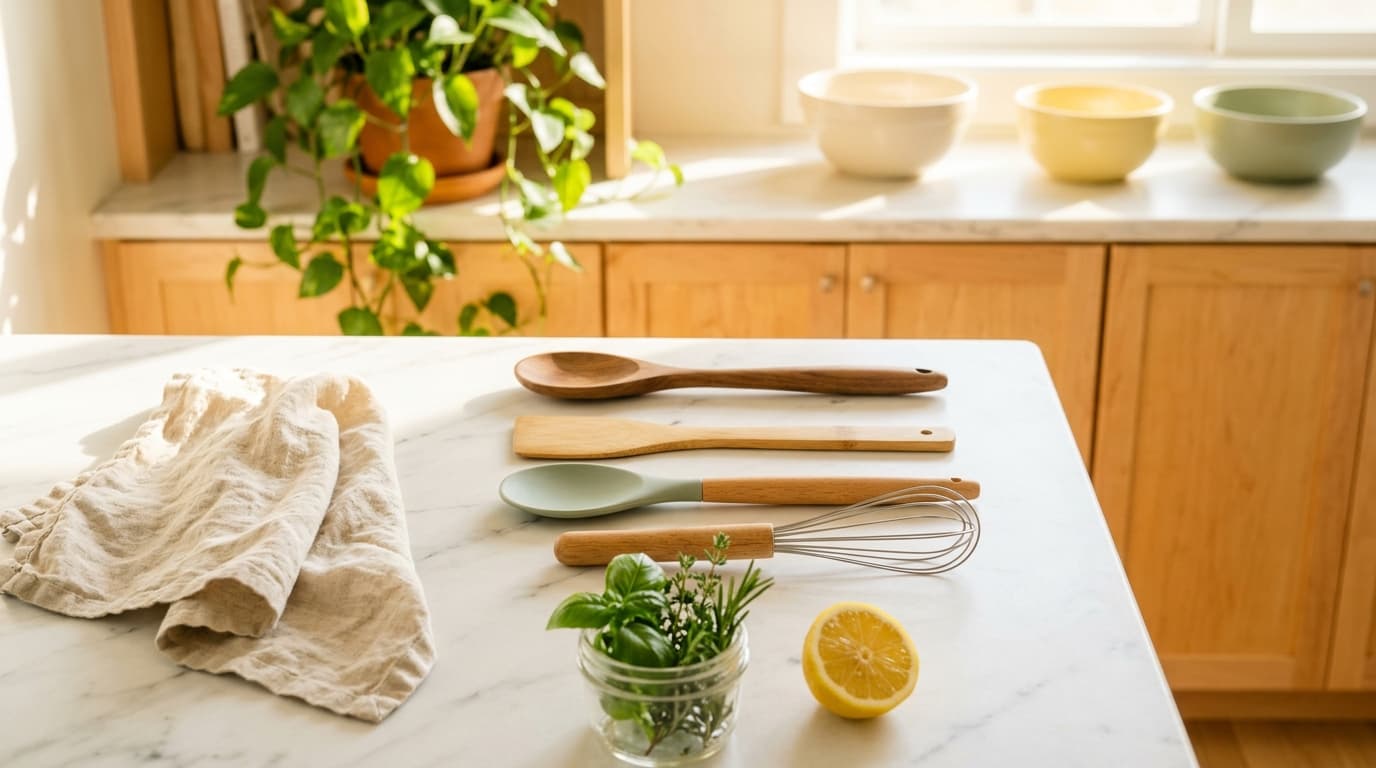
The short answer: the best non-toxic kitchen utensils are made from solid stainless steel, untreated or naturally finished hardwood, and food-grade silicone. Those three materials cover nearly every job in a kitchen, and none of them shed plastic particles or flaking coatings into hot food. What I would steer you away from is the cheap black plastic spatula set, the melamine spoon, and anything "nonstick-safe" that is really just thin nylon designed to not scratch a pan you should probably replace anyway.
Here is the honest part: utensils are one of the lowest-stress swaps in the whole kitchen. They are inexpensive, they last for years, and you do not need to buy them all at once. This is the hub page for our whole utensils cluster, so I will compare the materials, look at what the research actually says about black plastic and stainless steel, give you a simple pairing rule for each type of pan, and point you to the deeper guides when you want them: wooden utensils and the sets worth buying, what the research says about silicone, and food-grade silicone picks. This article contains affiliate links. If you buy through them we may earn a small commission at no extra cost to you, and it never changes which products we recommend.
What makes a kitchen utensil "non-toxic" in the first place?
A utensil earns the "non-toxic" label when it does not transfer anything unwanted into your food under normal use, mainly heat, acid and scraping. That rules out two things most people never think about: the material itself (does it leach?) and any coating or dye on top of it (does it flake?).
The biggest offenders are soft plastics and nylon. Black plastic utensils have drawn specific attention because some are made with recycled electronic plastic, which can carry flame retardants (more on the actual study below). The chemicals worth getting out of your kitchen tend to be the ones that hide in soft, cheap, high-heat-exposed items, and utensils tick all three boxes.
This is also where the buildup effect matters. One stir with a nylon spoon is nothing. But the spoon that lives in the pan every single day, through years of hot dinners, is exactly the kind of small, repeated exposure worth removing when the swap is this cheap.
The safest utensil materials, compared
There is no single "best" material. There is a best material for each job, and a sensible kitchen mixes two or three. Here is how the main options actually stack up.
| Material | Heat safe | Leaching risk | Best for | Watch out for |
|---|---|---|---|---|
| Stainless steel | Very high | Very low | Serving, mixing, cooking in steel pans | Scratches nonstick coatings |
| Hardwood (untreated) | High (not for soaking) | Very low | Stirring, nonstick-safe, everyday cooking | Needs oiling, hand wash only |
| Food-grade silicone | High (check the rating) | Low when truly food-grade | Heat-safe flipping, scraping bowls | Fillers in cheap "silicone" |
| Bamboo | Medium | Low (watch the glue) | Light stirring, salad tools | Adhesives in laminated bamboo |
| Nylon / black plastic | Low to medium | Higher at high heat | Honestly, skip it | Recycled-plastic contaminants |
| Melamine | Low | Can leach when hot | Cold serving only | Never use with hot food |
Stainless steel: the workhorse
Solid, single-piece 18/8 or 18/10 stainless steel is about as stable as kitchen metal gets. It releases very little into food under normal utensil use (the nickel nuance is below) and it handles any temperature you will hit on a stovetop. My own cookware is mostly stainless steel, no Teflon at all, and steel utensils pair naturally with it. The one rule: never drag steel across a nonstick surface. If you still run nonstick pans, keep steel for your stainless and cast iron.
Wood: quietly one of the safest choices
A plain wooden spoon is gentle on every pan, surprisingly hygienic when it is kept dry, and free of coatings entirely when it is untreated or finished with food-safe oil. The trade-off is care: hand wash, dry it, oil it occasionally, and do not leave it soaking. Wood deserves its own deep dive, so see why wood is one of the safest utensil choices for how to pick and care for it.
Silicone: great, if it is genuinely food-grade
Food-grade silicone is heat-stable and does not react with food, which makes it excellent for flipping and scraping bowls clean. The catch is quality: cheap "silicone" can contain fillers that make it leach. The pinch test and a few other checks sort the real stuff from the fakes, and I walk through all of it in are silicone utensils really non-toxic.
What the black plastic study actually found
In 2024, researchers published a study in the journal Chemosphere that screened 203 black plastic household products, kitchen utensils among them, for flame retardants. Flame retardants turned up in most of the products they analyzed, including deca-BDE, a restricted brominated flame retardant, and the pattern pointed to recycled electronics plastic ending up in kitchenware. The NIEHS explains why this family of chemicals gets scrutiny: some are linked to hormone disruption and they persist in the body and the home.
Then came the part most headlines skipped. The authors published a correction: they had made a calculation error in the reference dose they compared against, and the estimated daily intake from contaminated utensils turned out to be roughly an order of magnitude below the US reference dose for that compound. So the honest summary is this: black plastic utensils can contain flame retardants that have no business near food, the exposure from one spatula is small, and they are still the first thing I would retire from the drawer. Small, avoidable and cheap to replace is exactly the kind of exposure worth removing.
Stainless steel grades and the nickel question
Stainless steel labels look cryptic, but the numbers are just the chromium and nickel content:
| Label | What it means | Good for |
|---|---|---|
| 18/10 | 18% chromium, 10% nickel | Premium utensils and cookware, most corrosion-resistant |
| 18/8 (304) | 18% chromium, 8% nickel | The everyday standard for food contact |
| 18/0 (430) | About 18% chromium, no nickel, magnetic | Nickel-sensitive households; a little more prone to rust spots |
Is nickel worth worrying about? For most people, no. A study that cooked tomato sauce in stainless steel for hours found that nickel and chromium do leach into acidic food, most with brand-new steel and long cooking times, and that leaching dropped and leveled off after several cooking cycles. The authors flag it mainly for people with nickel allergy. A spoon that stirs for a minute is a very different exposure from a pot that simmers sauce for six hours. If someone in your home is nickel-sensitive, choose 18/0 utensils and read whether ceramic or stainless cookware suits you better.
What kitchen utensils are actually non-toxic, and which to skip?
If you want a blunt verdict: buy stainless steel, wood, and good silicone. Skip black nylon sets, melamine spoons, and anything sold as "won't scratch nonstick" that does not name its material. "Won't scratch nonstick" is a clue the tool is soft plastic, and soft plastic plus daily high heat is the combination you are trying to leave behind.
A few things I would not lose sleep over. Bamboo is fine for light work; just prefer solid bamboo over the laminated kind glued together with who-knows-what. Nylon is not a crisis if you already own it and use it gently, but I would not buy more. And you do not need to throw out a working spatula today. Use it up, then replace it with something better. One swap beats no swap, and nobody needs to gut their drawer in an afternoon.
I learned that the expensive way. When I first saw how many questionable ingredients were hiding in ordinary household things, I was genuinely shocked and tried to replace everything at once. It got pricey fast and it collided with real family life. Utensils are one of the few places where going slow costs you almost nothing: they are cheap, so you can simply retire the worst offenders first.
My priority order: what to swap first
Not all utensils are equal. The ones that sit in hot food the longest, and touch the most food, are the ones to replace first. Here is the order I would actually follow.
- The everyday cooking spoon or spatula. It lives in the pan at high heat daily. If it is black nylon, this is your first swap. Go wood or silicone.
- The slotted turner you flip with. High heat, constant contact. Stainless for steel pans, silicone for coated ones.
- The ladle and serving spoons. Hot soups and sauces sit on these. Stainless is perfect and basically permanent.
- Whisks and tongs. Steel is the obvious pick; look for silicone tips only if you cook in coated pans.
- Salad servers and cold-use tools. Lowest heat, lowest priority. Wood or bamboo, no rush.
The rule underneath all of it: the hotter the job and the longer the contact, the sooner it is worth swapping. A cold salad tosser can wait. The spoon in your simmering sauce cannot.
If you want the companion project, clearing the soft plastics out of your kitchen pairs beautifully with upgrading utensils. See how to detox your kitchen of plastic step by step for the full walk-through so I am not repeating it here.
Which utensil for which pan?
A utensil only makes sense next to the surface it touches. Here is the pairing I use:
| Cooking surface | Best utensils | Avoid |
|---|---|---|
| Stainless steel pans | Stainless, wood, silicone | Nothing in particular |
| Cast iron and carbon steel | Stainless (great for scraping), wood | Leaving silicone resting on a very hot pan |
| Ceramic-coated pans | Wood, food-grade silicone | Metal, which wears the coating |
| PTFE nonstick (until you replace it) | Wood, food-grade silicone | Metal and abrasive pads |
| Air fryer baskets | Wood or silicone-tipped tongs | Metal on any coated basket |
| Bakeware | Silicone spatulas, wood | Metal knives on coated pans |
If you are still running nonstick, PFAS-free nonstick pans and non-toxic bakeware are the matching upgrades. For the air fryer side of the kitchen, the non-toxic air fryer guide covers baskets, liners and the tongs you reach in with.
Are non-toxic kitchen utensils dishwasher safe?
Mostly, with one exception. Stainless steel and quality silicone are dishwasher safe and shrug off hot cycles without a problem. That is a genuine advantage if a dishwasher-safe set is what you are after.
Wood is the exception. Dishwashers dry it out, swell it and crack it over time, so wooden utensils are hand-wash only. That is the real trade-off with wood: it is one of the safest materials and the gentlest on pans, but it asks for a little care in return. If hand washing utensils is a non-starter in your house, lean toward a stainless-and-silicone set and keep just a couple of wooden spoons for the jobs they do best.
Labels and claims worth trusting
Utensil packaging is full of words that sound reassuring and mean little. Here is how I read it:
- "Food-grade" or "food-safe." The baseline you want on silicone and on wood finishes. It means the material is made for food contact, not that anyone independently tested your set.
- "BPA-free" on silicone or steel. True but beside the point: neither material is made with BPA. It only matters on plastic.
- "Platinum-cured silicone." A genuine quality marker; the platinum catalyst leaves fewer curing byproducts than the standard peroxide cure.
- LFGB. A German food-contact standard some silicone makers test to. Useful when the brand shows the test, not just the logo.
- FSC on wood. Tells you about responsible forestry, not about toxicity. Nice to have, not a safety claim.
- "Nonstick-safe" or "won't scratch." Usually means nylon or soft plastic. Check the material list.
- "Non-toxic." Not a standard. Look past it for the actual material.
Caring for each material, and when to replace it
- Stainless: dishwasher safe and effectively permanent. Replace only if a joint or handle fails.
- Wood: hand wash, dry promptly, oil every month or two. Replace when it cracks deeply or stays rough and fuzzy after oiling.
- Silicone: dishwasher safe. Replace when it tears, turns permanently sticky or oily, or warps from contact with a burner.
- Nylon and plastic: replace when edges melt, fray or discolor, and replace with one of the three materials above.
A gentle natural dish soap is all any of them need.
Building the best non-toxic utensil set
You do not need a matching 20-piece block. You need maybe six tools that cover everything, in the right materials. Here is the set I would build from scratch:
- A stainless steel slotted turner and a solid serving spoon. Permanent, inert, dishwasher safe.
- One or two wooden spoons for stirring and for anything cooked in a coated or cast iron pan.
- A food-grade silicone spatula for scraping bowls and flipping delicate food.
- Stainless tongs and a stainless whisk. Both last decades.
Buy these as singles or small sets rather than a giant bundle, because most big sets pad the count with nylon pieces you will never use. If you want an all-in-one option, look for a set that is explicitly stainless-and-silicone or solid wood, with no "nylon" buried in the material list.
Utensils are only half the kitchen, of course. If this swap has you eyeing your pans next, cookware is the bigger decision and it deserves a proper comparison.
Where utensils fit in the bigger kitchen picture
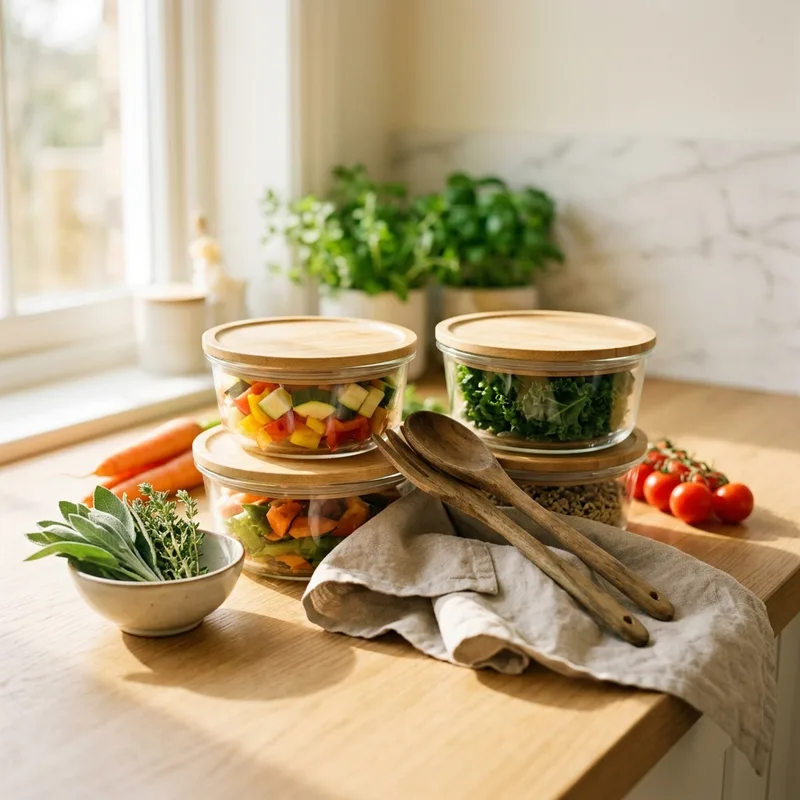
Utensils are a low-cost, high-satisfaction swap, but they are not where the biggest exposure lives. In my view, food itself and the containers you store and heat it in matter more. Glass food storage was the easiest win I ever made: a few sets, bought once, and they simply last. (I never heat food in a storage container either; it goes on a plate first.) If you want that swap, see glass food storage containers.
For the full map of kitchen swaps in order, the Food & Kitchen hub lays them out so you can tackle them at your own pace and budget. There is no prize for doing it all this week.
Safer Swaps
Start here, easiest and highest impact first, and use up what you have before you replace it.
- Swap your daily cooking spoon. If it is black nylon, replace it first with a wooden spoon or a food-grade silicone one. Cheapest, highest-contact, highest-heat swap you can make. Full detail in non-toxic wooden utensils and non-toxic silicone utensils.
- Add two stainless steel basics. A slotted turner and a serving spoon in solid 18/8 steel (18/0 if anyone at home is nickel-sensitive). Durable, dishwasher safe, effectively permanent.
- Replace soft plastic storage over time. As plastic containers wear out, switch to glass food storage one set at a time.
- Match the kids' tools too. Small spoons and plates are their own category; see non-toxic kids plates and utensils.
The Bottom Line
The best non-toxic kitchen utensils are stainless steel, untreated wood and genuine food-grade silicone, and the smartest move is not to buy a whole new set. It is to pull the one black nylon spoon that lives in your hottest pan and replace just that with a wooden or silicone one this week. That single swap removes your highest-heat, highest-contact exposure for a few dollars, and you can build out the rest of the drawer whenever it suits your budget.
Sources: EPA on PFAS and household chemicals, FDA on food-contact substances, NIEHS on flame retardants, Chemosphere black plastic study (2024), stainless steel nickel and chromium leaching study.