If you cook for a crowd, the best non-toxic air fryer toaster oven is the one with an uncoated stainless steel interior and parts that are explicitly free of PTFE and PFOA, so the hot air is never blowing across a nonstick coating. For larger households, my top pick is the Ninja French Door Premier: it is stainless-built and handles real batch sizes; just check what its included crisper basket and trays are made of, as I explain below. If you prefer a ceramic interior, GreenLife and Our Place both state their coatings are PFAS-free.
Here is the thing nobody selling these ovens wants to lead with: the countertop air fryer oven is a different animal from the little basket fryer. It is bigger, pricier, and usually marketed on features (dehydrate! proof dough! toast nine slices!) instead of on what the inside is actually made of. This guide flips that around. We will look at interior materials first, coating claims second, and features last, because a feature you use twice a year is not worth cooking your family's dinner on a mystery coating every night.
Affiliate disclosure: some links below are affiliate links. If you buy through them, we may earn a small commission at no extra cost to you. It never changes which products we recommend or what we say about them.
What "Non-Toxic" Actually Means in a Countertop Oven
Forget the word "non-toxic" on the box for a second. In this category it comes down to three practical questions:
What is the interior made of? The walls, floor, and ceiling of the cooking chamber. Uncoated stainless steel is the gold standard here. It takes high heat without shedding anything, it does not rely on a nonstick layer, and it lasts for years. Enamel and bare metal are fine too. What you want to understand is whether the hot, moving air is passing over a nonstick coating on its way to your food.
What are the racks, trays, and baskets made of? This is where "stainless steel oven" claims quietly fall apart. Plenty of stainless-bodied ovens ship with a nonstick-coated air fry basket or crisper tray. Those accessories sit directly under your food in the hottest, fastest-moving air. They matter more than the walls.
Is the coating (if any) disclosed? PTFE is the slick nonstick layer; PFOA was an older processing chemical now phased out. A brand that is confident about its materials will say "PTFE-free" and "PFOA-free" plainly. Vague "healthy coating" language is marketing, not a standard. When in doubt, I treat it as coated.
For the full science on why heated nonstick coatings get scrutiny, and how hot they have to get before it matters, see our non-toxic air fryer materials guide. And if you want the material comparison in depth, Stainless Steel Air Fryers: Are They Really the Safest Interior Option? is the companion piece.
The Trade-Off Nobody Tells Big-Batch Buyers
Here is the honest tension in this category. The ovens with the cleanest, most transparent stainless interiors are usually the premium ones. The giant-capacity bargains often win on size and lose on coating disclosure. You are frequently choosing between more transparency and more cubic inches of chicken.
My rule: pick the largest oven with a stainless interior you can afford, then replace or avoid any coated accessory it ships with. An uncoated stainless or steel mesh basket is cheap insurance, and it makes a vague-coating oven far less of a compromise.
Our Top Picks at a Glance
| Product | Best For | Key Material or Certification | Why It Wins |
|---|---|---|---|
| Ninja French Door Premier FO101 | Best Overall | Stainless construction, 20.3 Qt | Huge French-door space for meal prep |
| Our Place Wonder Oven | Best Coating Transparency | PFAS-free, PTFE-free coating | Brand built around non-toxic materials |
| GreenLife Toaster Oven Air Fryer | Best PFAS-Free Ceramic Interior | Ceramic nonstick, PFAS-free (per the maker) | Lighter, affordable ceramic option |
Best Overall: Ninja French Door Premier FO101
If your dinners mean two full sheet pans at once, the Ninja's 20.3 Qt French-door design is the sweet spot between capacity and footprint. The oven is stainless steel construction, the French doors make loading large trays easy, and the ten functions cover nearly everything a second oven would. My one note sits with the accessories: Ninja's included crisper basket and trays may carry nonstick coatings, so read the materials sheet and swap in an uncoated stainless basket if you want to be thorough.
Pros:
- Large 20.3 Qt capacity with convenient French-door access
- Stainless steel construction on the body
- Versatile 10-in-1 functionality for a true one-appliance kitchen
Cons: The nonstick accessories deserve scrutiny; plan to use or buy uncoated trays for the food that sits closest to the heat.

Best Coating Transparency: Our Place Wonder Oven
Our Place built its whole brand on non-toxic, PFAS-free, PTFE-free materials, and the Wonder Oven carries that through. The 6-in-1, 2-rack design is compact and efficient, which is a genuine strength if counter space is tight but you still want to cook more than a single tray at a time. The honest limit is capacity: at 13 Qt it is the smallest here, and a very large household may find it filling up fast on a busy night.
Pros:
- Brand known for PFAS-free, PTFE-free coatings and clear material claims
- Compact 2-rack design handles bigger batches than a basket fryer
- Attractive countertop footprint
Cons: 13 Qt may feel limiting for very large households or heavy meal preppers.

Best PFAS-Free Ceramic Interior: GreenLife Toaster Oven Air Fryer
If you like a nonstick feel but want to stay away from PTFE, GreenLife is the brand built around ceramic. Its countertop toaster oven air fryer pairs a stainless steel body with a ceramic nonstick interior and tray that the maker states are free of PFAS, PFOA, lead and cadmium. It is a smaller, more affordable box than the French-door ovens, so it suits households that want a second oven for weeknights rather than a full meal-prep station.
Pros:
- Ceramic nonstick interior and tray, PFAS-free per the maker
- Stainless steel exterior
- Compact footprint for everyday air frying, toasting and baking
Cons: Ceramic coatings wear faster than bare stainless, so treat it gently (no metal tools, no abrasive scrubbing) and expect to retire the tray sooner than a steel one.

How We Chose
We ranked these on low-tox criteria first: interior material (uncoated stainless scores highest), whether PTFE and PFOA are explicitly ruled out, and how clearly the brand discloses what its surfaces and accessories are made of. Capacity and versatility broke ties for this larger-household audience. We have not tested these ovens in our own kitchen; these assessments are based on published materials and manufacturer disclosures, which is exactly why transparency weighs so heavily in the ranking.
The Accessory Problem (Read This Before You Buy Any of Them)
In our home, cookware is mostly stainless steel and we use no Teflon (PTFE) at all. That same logic applies to oven accessories. A stainless-bodied oven with a coated crisper tray is only as clean as the surface your food actually touches, and in an air fryer that surface is the tray in the fast-moving heat.
So whichever oven you pick, check the basket and trays. If they are coated and you would rather not use them, an uncoated stainless or steel-mesh air fry basket runs cheap and solves it. This is also why I would not panic over an oven with slightly vague wall claims if the interior is stainless and you control the accessories: you can engineer around it.
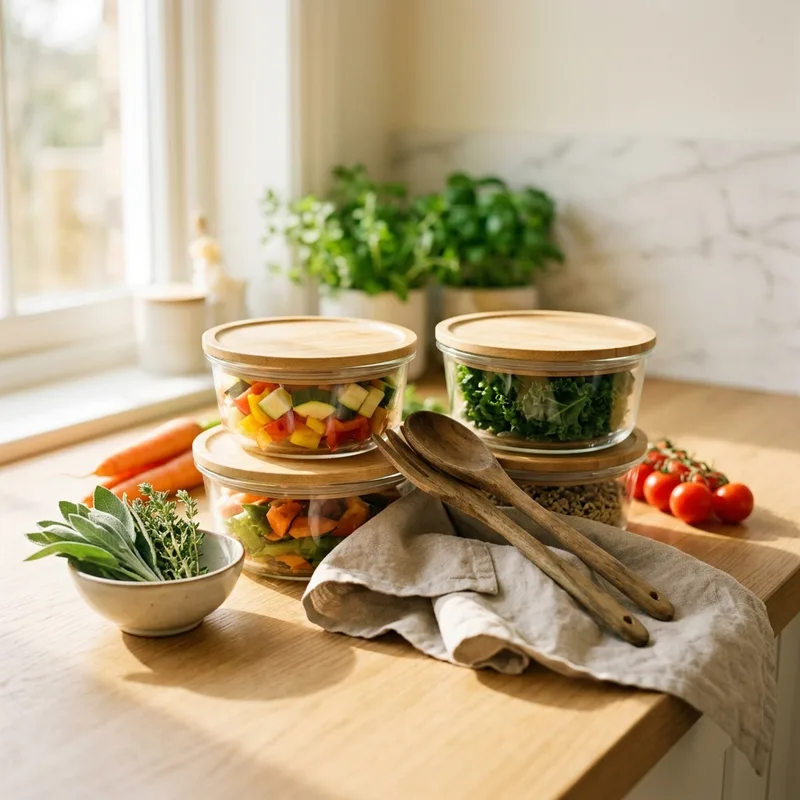
For the parts of your kitchen that live outside the oven, wooden utensils and glass food storage are the easy wins. Switching to glass storage was almost too easy in our home: a few sets, bought once, and they simply last. One habit worth keeping no matter what you cook on: never heat food in a plastic storage container. Food goes on a plate, the plate goes in the oven or microwave.
Countertop Oven or Basket Air Fryer?
If you are not sure you need an oven-style machine at all, here is the honest comparison:
| Basket air fryer | Air fryer toaster oven | |
|---|---|---|
| Capacity | Best for one to three people | Two racks or a full tray for families |
| Crisping | Faster, more intense airflow | A little slower; rotate trays for even browning |
| Food-contact surfaces | Usually one coated basket | Walls, racks, trays and basket, so more parts to check |
| Coating-free options | Stainless or glass baskets exist | Stainless interiors with bare racks are common |
| Also does | Air fry, roast, reheat | Toast, bake, broil, dehydrate, often replaces a second oven |
The rule I use: if you are regularly running two or three batches in a basket fryer to feed everyone, an oven-style machine with a stainless interior saves time and gives you more bare-metal cooking surface. If you cook for one or two, a glass or stainless basket air fryer is simpler and smaller.
What to check on any countertop oven listing
- Interior walls: "stainless steel interior" stated in the specs, not just "stainless exterior."
- Racks: bare chrome or stainless wire racks are standard; dark racks are usually coated.
- Air fry basket and crisper tray: the part most likely to be nonstick. Look for "PTFE-free" or plan to swap in an uncoated stainless basket.
- Baking pan and crumb tray: often enamel or nonstick. Enamel is fine; nonstick is where a parchment liner or your own stainless sheet pan helps.
- Coating disclosure: a brand that names the coating ("ceramic, PTFE-free") is a better bet than one that says "healthy nonstick."
Care, Longevity, and When to Replace
Stainless interiors are the low-maintenance heroes here: warm water, a non-abrasive pad, and they hold up for years. If you do use a coated accessory, inspect it. Once a nonstick surface is scratched, flaking, or chipping, retire it. A coating that stays intact behaves very differently from one that is breaking down, and a damaged tray is the clearest reason to swap.
Do not throw out a working oven to chase a "cleaner" one. Use up what you have, and when it genuinely wears out, upgrade to a stainless interior. For the broader principle of why small, steady exposures add up, The Toxic Buildup Effect is worth a read.
What the Research Actually Says
Let me keep this calm, because the internet does not. PTFE-based nonstick coatings are stable at normal cooking temperatures; the concern is overheating and degradation of worn coatings, which is why intact surfaces and uncoated accessories matter. The FDA regulates food-contact materials, and the EPA tracks the broader PFAS family. The sensible takeaway is not fear; it is to reduce the number of hot coated surfaces your food touches where you easily can. An uncoated stainless interior does exactly that.
Safer Swaps
Use up what you have, then switch in this order:
- Swap the coated air fry basket or tray first. It is the surface closest to your food in the hottest air, it is cheap to replace with uncoated stainless, and it instantly upgrades even a vague-coating oven.
- When the oven itself wears out, move to a stainless interior. The Ninja is the stainless pick here. For the full material breakdown across the category, see Best Non-Toxic Air Fryers and, if you want zero coating anywhere, Glass Air Fryers.
- Round out the kitchen with glass storage and uncoated utensils so the oven is not the only clean surface in the room.
The Bottom Line
For a larger household, buy the biggest oven with a genuinely stainless interior you can afford: the Ninja French Door Premier is the one I would start with, and GreenLife or Our Place if you would rather have a PFAS-free ceramic interior. Whichever you choose, do one thing this week: check the air fry basket. If it is coated and that bothers you, order an uncoated stainless replacement. That single, inexpensive swap does more for your daily exposure than agonizing over which premium oven to buy. For the rest of the kitchen, start at our Food & Kitchen hub.