A glass air fryer cooks your food inside a clear glass bowl or glass container, rather than in a metal basket lined with a nonstick coating. That one design choice is the whole point: there is no PTFE, no PFAS, no ceramic layer that can chip on the main cooking surface, because the vessel itself is glass. So yes, a glass air fryer is about as non-toxic as the category gets, with one caveat I will come back to: the small parts inside, like the crisper plate or rack, are not always glass. If your reason for shopping is "I want to remove the coating question entirely," a glass design is the cleanest answer available. If you already know you want one and just want models, the best non-toxic air fryers compared lines up the glass picks next to stainless and ceramic.
Now the honest part, because I am not here to sell you a fantasy. Glass air fryers are a tiny corner of the market, they cost more than a basic basket model, and glass breaks. Whether that trade is worth it depends entirely on what you cook and how much the coating issue actually bothers you. Let me walk you through how these things work, where they shine, where they frustrate, and who should skip them.
What a glass air fryer actually is
Most air fryers you see on a store shelf are a basket or a drawer with a nonstick coating, sitting under a heating element and a fan. A glass air fryer swaps that coated basket for glass, and you will see two main designs:
- Rotating glass bowl. An all-glass bowl that spins on a motorized base while hot air circulates around it. The Fritaire is the best-known example. Food tumbles as it cooks, which suits fries, wings and vegetables.
- Glass container or basket. A glass dish that slides or sits under the heating element like a regular basket, often with a crisper plate inside to lift the food. Ninja's Crispi and Cuisinart's glass basket model work this way.
In both, the main food-contact surface is glass. Sometimes a stainless steel rotisserie shaft, stirring paddle or crisper plate sits inside. That is the entire selling proposition: the vessel your food cooks in is a material that does not shed a coating, no matter how hot it gets or how many times you scrub it.
If you want the broader map of which materials and coatings hold up, we cover that in Non-Toxic Air Fryers: Which Materials and Coatings Are Actually Safe?. This article is specifically about the glass branch of that family.
Are glass air fryers non-toxic? How the design removes coating concerns
Here is why the coating conversation disappears with glass. The worry with conventional air fryers is the nonstick layer: PTFE (the material branded as Teflon) and the broader PFAS family, the "forever chemicals" that can break down when a coated surface is overheated or scratched. We dig into what the heat research genuinely shows, and what it does not, in our air fryer materials guide and in Is Nonstick Cookware Toxic?.
Glass sidesteps all of it. Glass is inert: it does not react with food, it does not leach a coating, and it does not degrade from heat the way a thin nonstick film can. The FDA regulates food-contact materials, and glass has long been treated as one of the stable, non-reactive options, which is part of why glass food storage is such an easy low-tox win too. See the FDA's overview of packaging and food contact substances for the regulatory backdrop.
So with a glass vessel, there is nothing to scratch into your food and nothing to overheat into fumes. For a coating-averse household, that is the appeal in one sentence.
The parts that are not glass (check these)
This is the step most glass air fryer reviews skip. "Glass air fryer" describes the main vessel, not every part your food touches. Before you buy, check:
- The crisper plate or rack. Glass-container designs usually lift food on a plate or rack. Silvery and reflective usually means bare stainless steel; dark grey or black and matte usually means a nonstick coating. If the listing does not say, ask the brand whether it is bare steel or coated, and if coated, whether it is PTFE-free.
- Rotisserie baskets, skewers and paddles. Usually bare stainless, but confirm.
- Lid seals and gaskets. These are typically silicone and sit near, not in, the food. Food-grade silicone is stable at air fryer temperatures; our silicone research guide explains the limits.
- The housing. Plastic in the outer body, away from the food and the hottest air, is a much smaller concern than any coated surface under your food.
If the only coated part is a crisper plate, you can often cook directly in the glass, use a bare stainless rack, or line the plate with perforated parchment once food is on it.
Borosilicate glass and thermal shock
Most glass air fryer vessels are made from borosilicate or tempered glass, the same families used in oven-safe bakeware. Borosilicate handles rapid temperature change better than ordinary glass, but no glass is shock-proof. The habits that keep it intact: let it cool before washing, never pour cold water into a hot vessel, do not set a hot bowl on a cold or wet stone counter, and do not use it if it is chipped or cracked. If the manual allows the dishwasher, the top rack is gentler than the bottom.
The trade-offs nobody puts on the box
I want you to buy with your eyes open, so here are the real downsides.
Fragility. It is glass. Drop the bowl, knock it against the faucet, or expose it to a sudden temperature shock and it can crack or shatter. A stainless basket survives a careless kitchen; a glass bowl asks for more care.
Price. Glass models sit at the premium end. You are paying for a niche design made in smaller volumes, so expect to spend meaningfully more than a mainstream basket fryer.
Very few models. This is not a crowded category. Your realistic choices are a handful of glass-bowl units, which means less competition on features and price, and fewer sizes.
Capacity and shape. A round rotating bowl handles different foods than a flat basket. Great for things that tumble (fries, wings, roasted vegetables). Less intuitive for a single flat tray of items you want to lay out in one layer.
Cleaning. Glass is easy to wipe and does not stain, which is a genuine plus. But the bowl is bulky to hand wash, and you will be careful with it precisely because it is breakable.
Glass vs the other non-toxic options
Glass is not the only coating-free route, and I would be doing you a disservice to pretend it is the obvious winner. Bare stainless steel baskets also give you no nonstick coating, usually at a lower price and without the fragility. And PTFE-free ceramic coatings are a real step up from Teflon, though not all "ceramic" claims are equal.
| Option | Coating concern | Fragility | Price | Best for |
|---|---|---|---|---|
| Glass bowl | None, fully coating-free | High, glass breaks | Premium | Households avoiding all coatings |
| Bare stainless basket | None, uncoated metal | Low | Low to mid | Budget-minded, coating-averse |
| Ceramic-coated | Low, PTFE-free but varies | Low | Mid | People who want easy release |
| Standard nonstick (PTFE) | The thing you are avoiding | Low | Low | Not our pick |
If a glass bowl feels like too much babysitting, read Stainless Steel Air Fryers: Are They Really the Safest Interior Option? and Ceramic-Coated Air Fryers before you decide. There is no single right answer, only the right answer for your kitchen.
My honest take on "best glass air fryer non toxic" searches
People search for the "best glass air fryer non toxic" model expecting a long shortlist. There is not one, because the category is small. The most talked-about all-glass option is the Fritaire, and rather than repeat its specs here I will point you straight to our full write-up: Fritaire All-Glass Air Fryer: What to Know Before You Buy.
My opinion, plainly: glass is the most coating-worry-free design on the market, and if that is your single priority, it delivers exactly what it promises. But I would not tell a busy family with small kids and a crowded counter to buy a breakable bowl just to chase a number like 100 percent. In my own home I did not manage to make everything perfect, and I stopped treating that as failure years ago. Every change in a healthier direction is a plus. A bare stainless basket already removes the coating problem at a fraction of the price and the fragility.
Where a glass air fryer genuinely earns its spot is a household that is scent- and coating-sensitive, cooks mostly tumbling foods, has the counter space, and will treat the bowl with care. For that person it is a joy. For everyone else, it is an option, not an obligation.
Who benefits most from a glass air fryer
Glass makes the most sense for a specific reader. You will get real value if you:
- Want to eliminate the coating question entirely, not just reduce it.
- Are sensitive to fumes or simply uneasy about any nonstick layer.
- Cook foods that tumble well: fries, wings, chickpeas, roasted vegetables.
- Have the counter and cabinet space for a bulkier unit.
- Will handle glass carefully and do not have a chaotic, bump-everything kitchen.
Glass is probably not for you if you are on a tight budget, cook mostly flat trays of food, hate babysitting fragile gear, or need a large capacity for a crowd. For bigger batches, an air fryer toaster oven usually serves a family better.
How it fits a low-tox kitchen (without overhauling everything)
A quick reality check, because I learned this one the hard way. When I first saw how many questionable ingredients sat in ordinary products, I tried to replace everything at once. It got expensive fast, and in a family you cannot just toss things people are using. So I changed what was clearly mine and let the rest happen gradually, as better options showed up.
Apply the same logic here. If your current air fryer still works and you are not overheating a scratched, flaking basket, there is no emergency. Use it up, then switch when it is time. An air fryer is one appliance; the bigger exposure levers in most kitchens are plastics and cookware. We lay out the sensible order in How to Detox Your Kitchen of Plastic and in the full Food & Kitchen hub.
And when you do cook, pair any air fryer with safe tools. Uncoated metal, wood and food-grade materials beat scratching a basket with the wrong utensil. One swap at a time beats a stressful, expensive clean sweep every time.
Safer Swaps
Use up what you already own, then switch in this order, easiest and highest impact first:
-
Stop overheating and scrubbing a worn basket. If your current fryer's coating is scratched or flaking, retire that basket. This costs nothing today and removes the clearest risk. Not all coatings are equal, so check what yours actually is in Is Your Air Fryer Coating Safe?.
-
When it is time to replace, pick a coating-free design. Glass if you want zero coating and will handle it with care; bare stainless if you want the same coating-free benefit at a lower price and without the fragility. Compare all three materials in Best Non-Toxic Air Fryers.
-
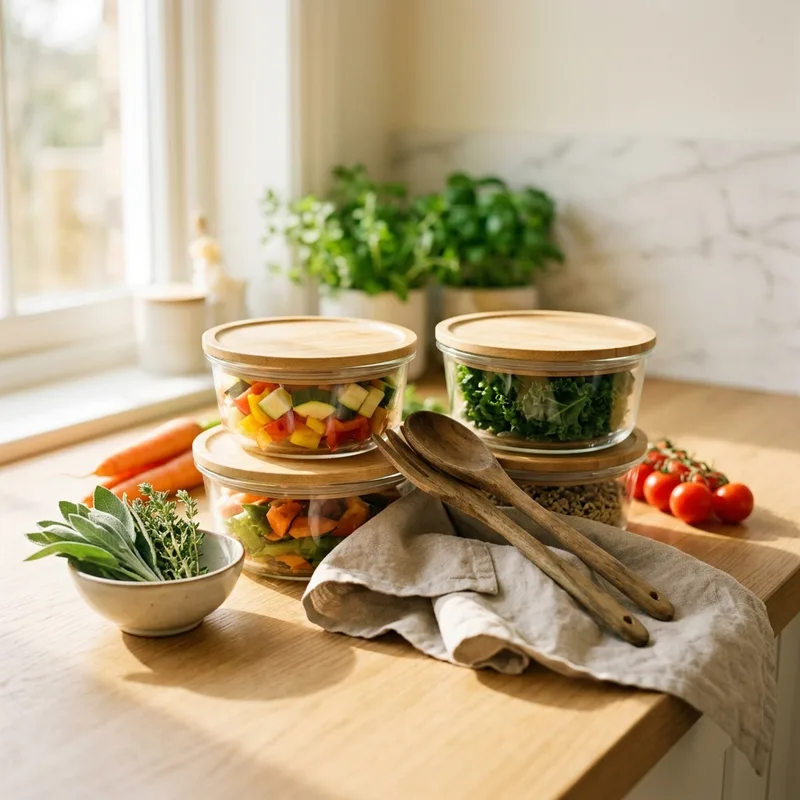
Upgrade what the food sits in and on. Glass food storage and uncoated cookware do more for your overall kitchen than any single appliance. Easy, affordable, and they last for years.
The Bottom Line
A glass air fryer is the most coating-worry-free design you can buy: nothing your food touches can shed a nonstick layer, period. You pay for that with a higher price, a breakable bowl and very few models, so it earns its spot only in households that truly want zero coating and will treat the glass with care.
Your one next step: decide whether coating-free-at-any-cost or coating-free-at-low-cost matters more to you. If it is the former, read the Fritaire review next. If it is the latter, start with stainless steel. Either way, you have already removed the coating question, and that is the win.