Here is the short, calm answer: a crib mattress is not automatically "toxic," and you do not need to panic about the one your baby is sleeping on tonight. US crib mattresses have to pass a federal fire-safety test, and manufacturers can meet it one of two ways: with a physical fire barrier (often wool, a knit sock, or fiberglass) or with added chemical flame retardants. The chemical route is the one worth avoiding, and the good news is that most reputable crib mattresses now skip it. So the real question is not "flame retardants: yes or no?" but "which method did this mattress use to pass, and can I confirm it?"
That distinction matters because flame retardants are a genuinely messy topic, full of outdated scares and overblown marketing. Some of the old chemistry really was a problem. A lot of what you read online, though, assumes every mattress is still packed with it. It is not. Let me walk you through what the evidence actually says, which labels mean something, and how to choose without spending an anxious weekend reading forum threads.
Why crib mattresses have flame retardants in the first place
It comes down to one rule. Under federal law, mattresses sold in the US must resist an open flame, a standard enforced by the Consumer Product Safety Commission. The goal is reasonable: slow a fire so a family has time to get out. The problem is historical. For decades, the cheapest way to pass was to spray or embed chemical flame retardants into the foam and fabric.
Those older chemicals, certain brominated and chlorinated compounds and organophosphates, are the source of the bad reputation. They do not stay locked in the mattress forever. They migrate out into household dust over time, which is how they end up in people. That is not fearmongering, it is just how semi-volatile chemicals behave.
What the evidence actually says
Here is where I want to be precise, because this is exactly the kind of topic where "linked to" quietly becomes "causes" and everyone panics.
Some flame retardants, particularly the older PBDEs (polybrominated diphenyl ethers), have been studied by the National Institute of Environmental Health Sciences and associated with effects on the developing brain and hormones in animal and human studies. "Associated with" is the key phrase. The strongest concern is about chronic, low-level exposure over years, and babies are more vulnerable because they spend enormous amounts of time on the mattress, breathe closer to it, and put everything in their mouths.
What the evidence does not say: that a modern crib mattress will harm your child, or that one night of sleep is dangerous. The US phased out the worst PBDEs years ago, and the industry has largely moved to physical barriers. The honest takeaway: this is a reduce-your-exposure situation, not an emergency. That is the whole spirit of the toxic buildup effect: small exposures matter over time, which is why it is worth getting the thing your baby sleeps on right, calmly.
The two ways a mattress passes the fire test
This is the single most useful thing to understand, so I will keep it clean.
| Method | What it is | What to know |
|---|---|---|
| Physical fire barrier | A built-in layer (wool, a knit "sock," silica, or fiberglass) that slows flame without added chemicals | The approach I would choose. Just check what the barrier is made of. |
| Chemical flame retardants | Compounds added to foam or fabric | The method worth avoiding. Harder to confirm by sight, so you rely on certifications. |
A barrier made of wool is my favorite: naturally flame-resistant, breathable, no added chemistry. A silica-based barrier is also fine. The one that surprises parents is fiberglass, which is a legitimate, chemical-free fire barrier used inside the mattress core. It is only a problem if the outer cover tears or is removed, releasing tiny glass fibers. My rule: fiberglass is acceptable if it is fully sealed and you never unzip the cover, but given the choice I would rather buy a mattress that does not use it, simply so a curious toddler and a zipper are never part of the equation.
The certifications that actually mean something
Marketing loves the words "natural," "non-toxic," and "eco." None of those are regulated. A certification is a third party checking the claim, which is the only reason to trust it. Here are the ones I look for, and the ones I ignore.
Worth trusting
- GREENGUARD Gold: tests the finished product for chemical emissions into the air, with stricter limits set for children and sensitive people. For a mattress, where off-gassing is the real-world concern, this is the one I weight most heavily.
- CertiPUR-US: applies to the foam specifically. It means the foam is made without certain flame retardants, heavy metals, and formaldehyde, and is low-VOC. If a mattress contains foam, I want this.
- GOTS (Global Organic Textile Standard): for the textile and fill, covering organic fiber content and restricted substances. A strong signal on an organic cotton or wool mattress.
- MADE SAFE: screens against a long list of known harmful chemicals. You can browse their certified products directly.
Marketing, not a standard
"Hypoallergenic," "baby-safe," "chemical-free," "green," and a leaf-shaped logo a brand designed itself. Skip them as proof of anything. If a listing leans hard on vibes and never names a real certification, that tells you what they could not get certified. Blunt, but true.
This label-reading habit is not baby-specific, by the way. It is the same muscle I use on everything I buy, and if you want the deeper version, decoding INCI names and ingredient language is the long game.
My honest take on the "all mattresses are poison" panic
I went through my own version of this years ago, and I will tell you what it taught me. When I first discovered how many questionable ingredients were hiding in ordinary products, I was genuinely shocked, and my gut reaction was to replace everything at once. It got expensive fast, and in a family it collides with reality: you cannot just throw out things that are working. What I learned was to change what is clearly mine to change, do it thoughtfully, and not let perfect become the enemy of done.
A crib mattress is a great example of a worth-it swap, because it is a one-time purchase your baby will breathe against for thousands of hours. That is very different from chasing a trendy, unproven upgrade. So no, I do not think you'll want to treat every mattress as toxic sludge. I think you'll want to buy one good one, confirm the certifications, and move on with your life.
How to choose: a simple priority order
If you only remember one section, make it this. In order:
- Confirm it meets the federal fire standard with a physical barrier, not added chemicals. Ask or read the product page directly. A trustworthy brand says exactly how it passes.
- Look for GREENGUARD Gold or CertiPUR-US (or both). Emissions first, foam chemistry second.
- Check what the fire barrier is made of. Wool or silica preferred; sealed fiberglass acceptable but not my first pick.
- If it is organic, look for GOTS. This verifies the "organic" claim rather than taking it on faith.
- Let it off-gas before use. Even low-VOC materials release a little at first. Unwrap it, let it air out in a ventilated room for a day or two, and you have cut the one exposure you fully control.
A worked example of reading a listing: if a crib mattress says "meets federal flammability requirements using a wool fire barrier, CertiPUR-US certified foam, GREENGUARD Gold certified," that is a yes. If it says "natural, baby-safe, eco-friendly, flame-resistant" with no named certification and no mention of how it is flame-resistant, that is a listing hoping you will not ask. Ask.
What about the rest of the nursery?
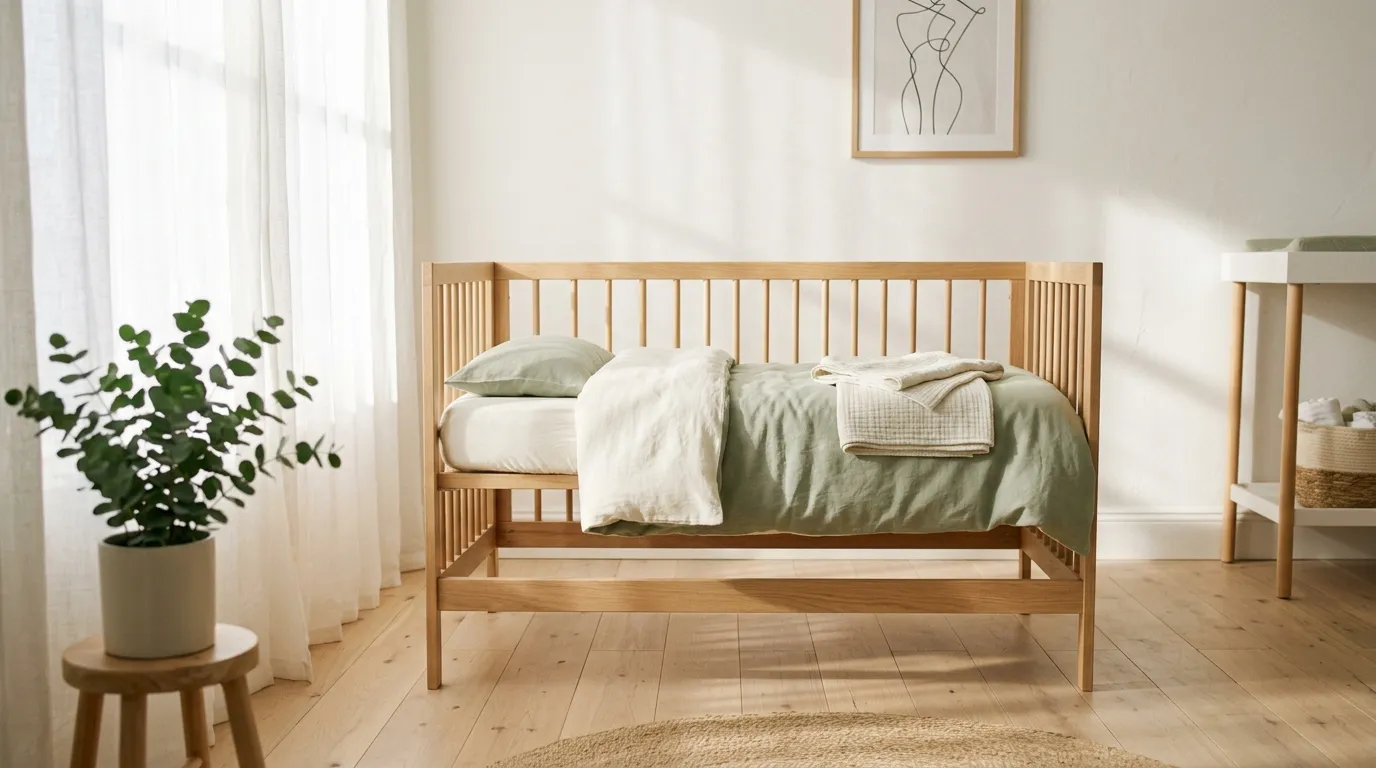
The mattress is the single most important piece because of sleep hours and direct contact, but it is one item in a room. Bedding, sleepwear (which has its own flame-retardant conversation), and furniture finishes all add up. Rather than cram all of that in here, I keep the nursery as a connected set of decisions: start with the mattress, then work through the non-toxic nursery checklist and the broader guide to safer choices from nursery to playroom at a pace your budget can handle. If you want the full picture of what matters most for kids, start at Children & Family.
Flame retardants also live in other products, so if you are curious which chemicals keep showing up across the home, our rundown of the top offenders to eliminate covers where they hide.
Safer Swaps
Use what you have if it is working and already certified. When you are genuinely in the market, here is the order I would spend in, easiest and highest impact first.
- Buy the mattress right the first time. This is a one-time, high-contact purchase, so it is the one place I would not cut corners. Choose a model that passes the fire standard with a wool or silica barrier and carries GREENGUARD Gold or CertiPUR-US. Our best non-toxic crib mattress guide narrows it down so you are not reading forum threads at 2 a.m.
- Add certified organic bedding next. Far cheaper than the mattress and an easy win, since sheets touch skin directly. See best organic kids bedding.
- Air out anything new before it enters the crib. Free, immediate, and it handles the off-gassing you can actually control.
The Bottom Line
Your crib mattress is probably not a toxic disaster, and you do not need to lose sleep over the one in the room right now. The thing worth doing is simple and one-time: when you buy, choose a mattress that passes the fire standard with a physical barrier instead of chemical flame retardants, and confirm it with a real certification like GREENGUARD Gold or CertiPUR-US. Do that once, let it air out, and you have handled the single highest-contact item in the nursery. One good swap beats a weekend of worry.