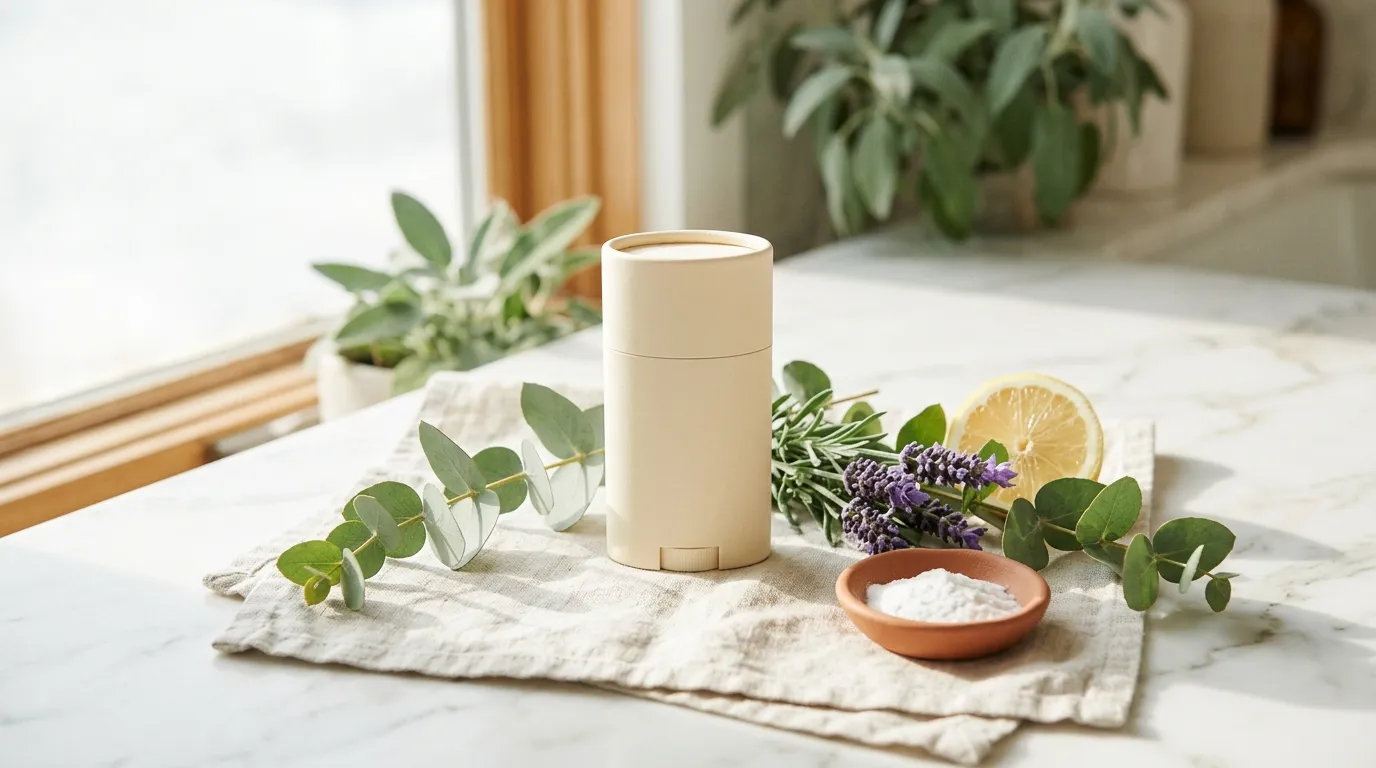
Let me clear up the most common confusion first: a non-toxic deodorant is not the same as an antiperspirant. Antiperspirants use aluminum salts to plug your sweat ducts so you stay dry. A deodorant does not stop sweat; it neutralizes the odor that happens when sweat meets bacteria. The best non-toxic deodorant is an aluminum-free one that controls odor with ingredients like baking soda, magnesium, charcoal or plant oils, and if your skin is sensitive, you want a baking-soda-free version. For most people I would reach for Each & Every, which is EWG Verified, and Native is the budget-friendly crowd-pleaser.
Deodorant was one of the first things I rethought when I started swapping out everything that touches my skin back in 2018. It goes onto thin, often freshly-shaved skin, and it stays on all day. By my own rule (anything that stays on your skin and covers real estate deserves priority), underarm products sit near the top of the swap list. So let's make this an easy, well-informed decision.
What "Non-Toxic" Actually Means on a Deodorant Label
The label "natural" is marketing, not a standard. Here is what genuinely matters when you read the back of the stick.
Aluminum-free. This is the headline swap. The research on aluminum in antiperspirants and breast cancer is not conclusive, and the National Cancer Institute says there is no clear evidence linking the two. I am not here to scare you. But if you would rather not apply a metal salt to your skin every day, aluminum-free deodorant does the job for most people, and that is a reasonable personal choice, not a panic.
No undisclosed "fragrance." The single word "fragrance" or "parfum" can hide dozens of ingredients the brand never has to list, including some you might want to avoid. I prefer deodorants scented with named essential oils or labeled fragrance-free. This matters enough that it has its own guide: see Is Fragrance in Products Safe?.
No phthalates or parabens. Phthalates, the chemicals that make fragrance last longer, often hide inside that "fragrance" label. Parabens are preservatives some people choose to skip. Clean deodorants generally avoid both.
A short, readable ingredient list. My thirty-second habit: before I buy any new personal-care product, I look it up on INCIdecoder. It takes half a minute and tells me what every ingredient actually is. Do that once and you will never read a label the same way again.
The One Ingredient That Decides Your Pick: Baking Soda
Here is the fork in the road that nobody warns you about. Baking soda (sodium bicarbonate) is a fantastic odor neutralizer, which is why so many natural deodorants use it. But it is alkaline, and on sensitive underarm skin it can cause redness, itching and sometimes a rash, especially right after shaving.
So the real decision rule is simple:
- Normal skin, strong odor control wanted? Baking soda formulas work beautifully.
- Sensitive skin, or you react to things easily? Choose a baking-soda-free formula that uses magnesium, arrowroot or zinc instead.
If you have never tried a natural deodorant, start baking-soda-free. It is the lower-risk entry point, and you can always move to a baking soda formula later if you want more power.
Our Top Picks at a Glance
| Product | Best For | Key Material or Certification | Why It Wins |
|---|---|---|---|
| Each & Every Natural Deodorant | Overall / sensitive skin | EWG Verified, vegan, baking-soda-free | Third-party verified ingredient safety |
| Native Deodorant | Proven crowd-pleaser | Aluminum-free, coconut oil, shea butter | Huge track record, easy to find |
| Little Seed Farm Deodorant Cream | Cleanest minimal formula | Small-batch cream, recognizable ingredients | Fewest ingredients of the four |
| Schmidt's Charcoal & Magnesium | Strong odor control | Charcoal + magnesium, 48H | Powerful formula at a friendly price |
Best Overall: Each & Every Natural Deodorant (EWG Verified)
If I had to hand one stick to a friend starting out, this is it. The reason is one word on the label: EWG Verified. That means an independent third party checked the full ingredient list against a public safety standard, so you are not just trusting the brand's own "clean" marketing. It is also vegan and baking-soda-free, which makes it a smart pick for sensitive skin.
Pros:
- EWG Verified, independent confirmation of ingredient safety
- Baking-soda-free, gentler on reactive or freshly-shaved skin
- Simple, aromatherapy-style scents from essential oils
Cons: It sits at the premium end of this list, around $20, so it costs more than drugstore natural options.

Best Proven Crowd-Pleaser: Native Deodorant
Native is the one almost everyone has heard of, and that popularity is earned: it has an enormous base of real-world users and a long track record of actually controlling odor. The coconut-and-vanilla formula leans on coconut oil and shea butter, so it goes on smooth and conditions the skin. If you want aluminum-free without overthinking it, this is the easy on-ramp.
Pros:
- Massive, long-standing user base signals reliable performance
- Naturally derived ingredients like coconut oil and shea butter
- Widely available and easy to repurchase
Cons: This formula contains baking soda, which can irritate sensitive underarms. If you react, switch to their sensitive (baking-soda-free) line or to Each & Every.

Best Minimal Formula: Little Seed Farm Deodorant Cream
This is the pick for people who want the shortest possible ingredient list. It is a small-batch cream rather than a twist-up stick, made with recognizable ingredients you could practically name from memory. The cream format actually lets you control exactly how much you use, and a jar lasts a long time.
Pros:
- Truly minimal, recognizable ingredient list
- Small-batch, clean cream formula
- A little goes a long way, so one jar lasts
Cons: It is a cream you apply with your fingers, which some people find messier or less convenient than a stick. (Tip: it softens with body heat, so warm a little between fingertips first.)

Best for Strong Odor Control: Schmidt's Charcoal & Magnesium
When people tell me natural deodorant "doesn't work," they usually mean they need more power. Schmidt's charcoal-and-magnesium formula is the one I would point them to. Activated charcoal helps absorb odor and magnesium supports odor control, and it comes in a two-pack, which makes the per-stick value very reasonable.
Pros:
- Charcoal and magnesium make for a genuinely effective formula
- Free of aluminum and common harsh additives
- Two-pack offers strong value
Cons: The 48-hour claim is optimistic for heavy sweaters; if you run warm, plan on a morning application rather than skipping days.

How We Chose
We prioritized aluminum-free formulas with transparent, readable ingredient lists, no undisclosed "fragrance" where possible, and third-party certification when available (Each & Every's EWG Verified status is the gold standard here). We looked at formula type (baking soda versus baking-soda-free) because that is the single biggest factor in whether a deodorant works for your skin. We have not tested every stick in our own bathroom; these picks are vetted on ingredients, certification and transparency, not on a lab trial we did not run.
The Adjustment Nobody Warns You About
Let me be honest about the part that surprised me most. Scent was the hardest adjustment in my whole low-tox switch. I gave up perfume and scented products, and at first the neutral smell of clean products felt like something was missing. The same thing happens with deodorant: when you stop using heavily fragranced sticks, you notice your own natural smell more for a week or two while your skin adjusts. It passes. If you want a little scent, choose a deodorant scented with named essential oils rather than mystery "fragrance."
There is also a genuine transition period when you come off aluminum antiperspirants. Your underarms have been plugged; now they sweat normally again. Give it two to three weeks before you judge a new deodorant. Some people do a one-time clay or charcoal "armpit detox" to speed this up, and honestly, I think that is more hype than help. Just be patient.
What to Avoid on the Label
A quick field guide for your next shopping trip:
- Aluminum (any form): aluminum chlorohydrate, aluminum zirconium. These make it an antiperspirant, not a deodorant.
- "Fragrance" or "Parfum" with no further detail: can hide ingredients you would rather skip, including phthalates.
- Triclosan: an antibacterial agent that has largely fallen out of use but still appears occasionally; skip it.
- Propylene glycol high on the list: not dangerous, but a common irritant for some people in leave-on products.
For the bigger picture on what belongs (and does not) in your skincare, see Toxic Ingredients in Skincare to Avoid.
When to Replace Your Current Deodorant
You do not need to throw out a working product to feel good about your choices. My rule across the whole house is: use it up, then swap. If you are halfway through a conventional antiperspirant, finish it, then switch when you reorder. The exception I would make is if the current one is irritating your skin, in which case stop sooner. A twist-up natural stick typically lasts two to three months with daily use; a cream jar lasts longer.
Deodorant is a small, inexpensive, low-risk swap, which is exactly why it is a great first move. It is cheaper than replacing your whole shelf at once, and the ongoing cost is about the same as a conventional premium stick. For a calm plan that does not overwhelm you, see How to Transition to Non-Toxic Personal Care.
Safer Swaps
Three moves, easiest and highest-impact first. Use up what you have, then switch.
- Swap your antiperspirant for an aluminum-free deodorant. If you have sensitive skin, start with a baking-soda-free formula like Each & Every; if you want proven, easy and affordable, start with Native. This is the swap that matters most because it is a daily, leave-on, large-area product.
- Match the formula to your skin. Reacting to redness or itch? Move to a magnesium- or arrowroot-based baking-soda-free stick. Need more power? Try charcoal and magnesium.
- Carry the swap through the rest of your bathroom. Once deodorant is sorted, your toothpaste and shampoo are the next easy wins. See Best Natural Toothpaste and Best Natural Shampoo & Conditioner, or work through the whole room with the Non-Toxic Bathroom Swaps checklist.
The Bottom Line
Aluminum-free deodorant works for the vast majority of people; the trick is matching the formula to your skin and giving it a two-to-three-week adjustment. My one clear next step for you: if you have sensitive skin or you are not sure, buy one baking-soda-free, EWG Verified stick like Each & Every and finish your current antiperspirant before you switch. One good swap beats a whole shelf you never get around to. For everything else on the clean beauty path, start at our Personal Care & Beauty hub.